
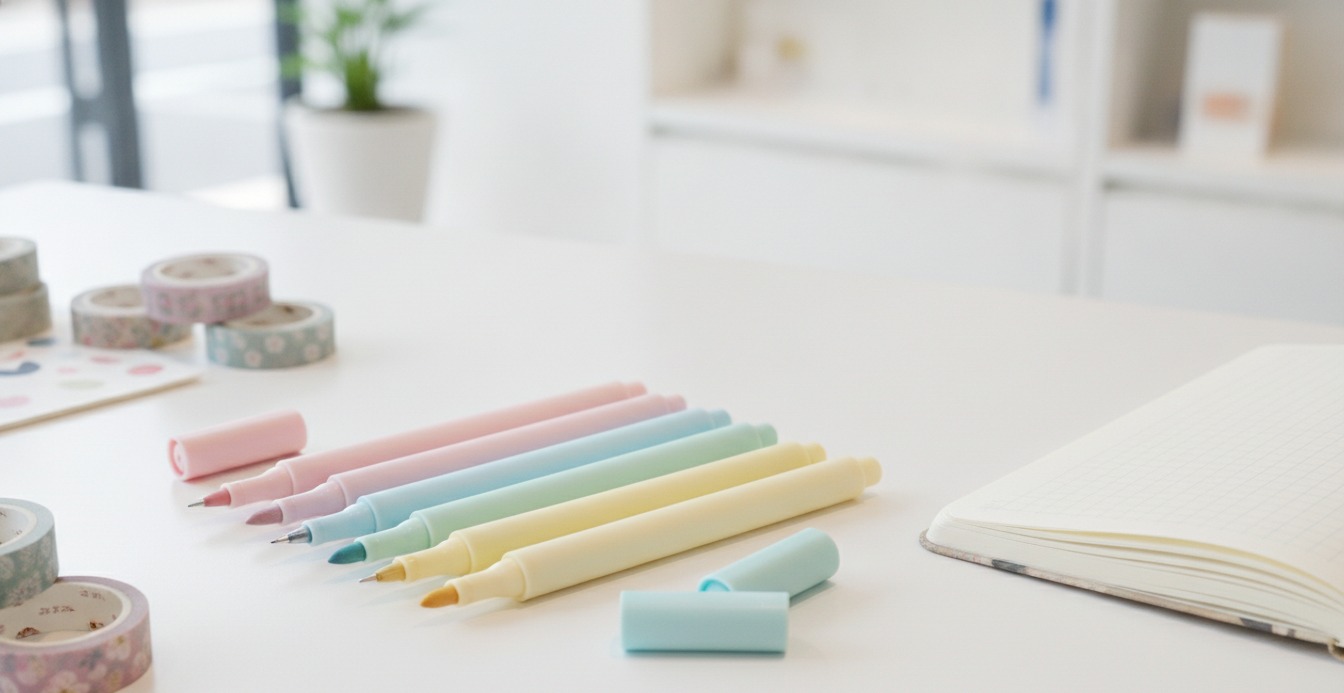
I was on my third cup of green tea when the email landed. It was 6:47 a.m. in Ningbo, and a Tokyo-based stationery distributor — one I’ve worked with for three years now — needed a restock order confirmed before the end of the Japanese business day. Not fluorescent yellow. Not neon orange. Not classic green. Every single line item on the purchase order was pastel. Lavender. Mint. Soft peach. The kind of colors that look like they belong in a Tokyo café window, not a classroom supply closet.
That moment crystallized what I’ve been seeing across our entire export desk at Ningbo Twohands Stationery for the better part of eighteen months. The pastel highlighter category isn’t just growing — it’s fundamentally reordering how Japanese and broader Asian-Pacific stationery buyers build their shelf assortments. And if you’re importing writing instruments for retail, the data I’m about to walk through matters more than any trend report I’ve read this year.
The Color That Moved the Needle: Pastel’s Quiet Takeover
The global stationery market has been projected to reach upwards of $242 billion, according to industry data tracked by Statista’s stationery outlook, and within that enormous pie, highlighting products have carved out a surprisingly resilient niche. But what the macro numbers don’t show you is the micro shift happening inside the category: pastel shades are eating fluorescent’s lunch. I see it in our order ratios. Two years ago, for every case of pastel highlighters we shipped to Japanese distributors, we shipped nearly three cases of classic fluorescent. Today, that ratio has almost completely inverted.
Part of this comes down to a generational pivot in how people use stationery. The highlighter was invented in the 1960s by Carter’s Ink Company, and for decades the technology didn’t change much — fluorescent ink, chisel tip, cheap plastic barrel. Today’s user, though, isn’t just underlining a photocopied textbook page. They’re decorating a bullet journal spread that’s going on Instagram. They’re color-coding a study guide that needs to feel calming to read, not aggressive. Pastel delivers the function of emphasis without the visual fatigue. I’ve personally tested dozens of our competitors’ products alongside our own TWOHANDS highlighter pens, and the readability difference between a fluorescent yellow streak and a soft pastel highlight after thirty minutes of study is genuinely measurable — your eyes simply relax faster on the pastel page.
Inside the Japanese Stationery Buyer’s Quality Checklist
I’ve sat through enough buyer meetings — both in person at our Ningbo facility and over video calls with Tokyo trading houses — to know that Japanese stationery buyers operate on a different set of quality criteria than most Western importers. They’re not just reading a spec sheet. They’re feeling the chisel tip scratch against paper. They’re holding the page up to a window to check ink bleed-through. They’re running a finger over the highlighted text two seconds after application to test dry time. Here’s what they consistently flag as non-negotiable:
Ink Consistency and Saturation Control
Pastel is deceptively hard to get right. If your ink saturation drifts too high, you lose the “pastel” quality and end up in a murky middle ground that’s neither soft nor bold — it just looks dirty. If it’s too weak, the text underneath becomes illegible once highlighted, defeating the entire purpose. Our TWOHANDS pastel highlighters — including the 8 Pastel Colors set (model 20208) — use water-based pigment ink with controlled saturation that lands in the sweet spot: enough opacity to make the highlighted text pop without drowning it. Buyers from Japan’s major stationery chains have specifically commented on this balance during factory audits, and honestly, maintaining that consistency across production runs is one of the things I lose sleep over — and one of the things that keeps reorders coming.
Chisel Tip Geometry and the Double-Width Standard
Japanese stationery culture has an almost obsessive relationship with line width. The standard chisel tip on quality highlighters needs to deliver both a 1mm fine line (for underlining individual characters) and a 4-5mm broad stroke (for covering entire lines of text). I’ve seen importers bring digital calipers to supplier meetings. They measure. Every TWOHANDS pastel highlighter ships with this dual-width chisel geometry because the procurement people demand it — and because it’s genuinely the right way to build a highlighter when you know it’s going to be used on everything from kanji characters to English-language business documents.
Ink Reservoir Capacity and Longevity
This is the quiet factor that separates repeat-purchase products from one-and-done disappointments. A typical TWOHANDS pastel highlighter carries a large ink reservoir designed for extended marking sessions — think semester-long study use, not a two-week project sprint. Japanese retail buyers calculate cost-per-meter-of-highlighting almost religiously. I’ve built that calculation into our own quality control benchmarks because I know if we hit it, the reorder emails keep coming. Our 25-color Note Marker set (model 21380) takes this even further with extended reservoirs across an unusually wide pastel palette, and it’s become one of our fastest-growing SKUs in the Japanese stationery channel precisely because it answers the longevity question with 25 distinct, usable colors.
Retail Shelf Economics: Why Pastel Earns Its Space
Let me share something that came up in a call with an Osaka-based retail buyer last quarter. They were re-planogramming their stationery aisle and had to decide between adding a third fluorescent SKU or introducing a second pastel collection. The math was surprisingly clear: pastel highlighters turn 1.7 times faster per linear foot of shelf space, and the average basket size for customers who bought pastel highlighters included 2.3 additional stationery items — nearly double the attach rate of fluorescent-only shoppers.
This isn’t magic. It’s psychology. When someone buys a TWOHANDS 6 Pastel Colors 2-Pack (model 20130), they’re not just buying a marking tool — they’re buying into an aesthetic. The soft pinks, muted greens, and gentle lavenders create a visual language that feels intentional and curated. That buyer is far more likely to also grab a matching fineliner set, a grid notebook, or washi tape that coordinates with the pastel palette. Shelf placement becomes ecosystem placement. I’ve watched this dynamic play out across enough retail environments to know that the brands treating pastel as a strategic category rather than a novelty color variant are the ones winning the replanogramming conversation.
The Japan Connection: Cultural Aesthetics Meet Export Logistics
The stationery industry has deep roots in both Western and Eastern manufacturing traditions, but the pastel highlighter trend has a particularly strong gravitational pull from Japan. Japanese consumers have been driving pastel preference for over a decade — think Mildliner, think of the broader “kawaii” aesthetic that softens every color palette it touches. What’s changed in the last three years is that Japanese importers are now sourcing pastel highlighters directly from Chinese manufacturers like us at scale, rather than relying exclusively on domestic production.
I’ve had candid conversations with procurement managers in Tokyo who told me, off the record, that their domestic pastel highlighter production costs have risen 22-28% since 2020 due to raw pigment pricing and labor availability. For a product category where the retail price point needs to stay accessible (typically ¥300-¥800 per unit on Japanese shelves), that margin compression is brutal. Importing from a Chinese supplier with verified manufacturing capability isn’t just a cost play — it’s becoming a structural necessity for maintaining shelf presence. Our Ningbo facility ships pastel highlighters that meet Japan’s rigorous JIS standards for stationery products while keeping landed costs at levels that let our distributor partners maintain healthy retail margins.
Compliance and Safety: The Quiet Gating Factor
Here’s something that doesn’t show up in marketing copy but absolutely controls which pastel highlighters land on retail shelves: regulatory compliance. Every shipment we send to Japan, Europe, or North America carries documentation confirming that our ink formulations comply with U.S. Consumer Product Safety Commission Art Materials guidelines, EN 71-3 (migration of certain elements), and ASTM D-4236 (chronic hazard labeling). Pastel pigments — particularly the softer greens and pinks — often require more complex pigment blending to achieve both color accuracy and regulatory compliance, and not every factory bothers to get this right. We do, because we know the alternative is a recall that erases years of buyer trust overnight.
The National Industry Business Services organization — NIBS — maintains resources for stationery manufacturers navigating international trade compliance, and I’d recommend any importer new to the category spend time understanding the compliance landscape before signing a purchase order. The cost of non-compliance isn’t just financial; in Japan’s stationery retail environment, where trust is the currency of long-term supplier relationships, a single safety incident can close doors permanently.
Inside the Reorder Cycle: Procurement Rhythms That Keep Shelves Stocked
If you’re a stationery importer considering adding pastel highlighters to your assortment — or scaling an existing pastel program — let me walk through what the procurement rhythm actually looks like from the supplier side. I manage it every day, and the patterns are consistent enough to be worth sharing.
Lead time reality. A standard container of pastel highlighters from our Ningbo facility to a Japanese port runs 5-8 days on the water, plus 2-3 days for customs clearance and inland distribution. But the upstream production lead time — from confirmed PO to container-loaded — is typically 30-45 days for standard SKUs and 45-60 days for customized packaging or private-label programs. Japanese importers who’ve built the strongest reorder reliability with us are the ones who forecast at 90 days and place replenishment orders at 60 days. The ones who wait until stock-out to reorder are the ones who lose shelf space to competitors.
MOQ considerations. Pastel highlighter production benefits from economies of scale on pigment mixing. Small runs under 3,000 units per color incur per-unit pigment waste costs that make the economics borderline. Our sweet spot for cost efficiency sits at 5,000-10,000 units per SKU, which aligns well with mid-size Japanese stationery chains managing 50-200 retail doors. For our larger distributor partners running nationwide distribution, the 25-color sets and bulk 2-pack assortments at volume MOQs have become the go-to configuration because they offer the widest palette at the most competitive per-unit cost.
Seasonal planning. Japanese back-to-school season kicks in February-March (the academic year starts in April), which means the reorder wave for pastel highlighters begins hitting our production schedule in November-December. The secondary peak — and one that first-time importers often miss — is the September-October window when Japanese retailers refresh their stationery aisles for the fall semester and the end-of-year gift-giving season. I’ve learned to pre-stage raw materials for pastel production by September to catch both waves without scrambling.
Evolving Past What the Textbook Said
The New York Times Wirecutter called pastel highlighters “the stars of my paper planner” and described them as “sophisticated” tools that “bring order and calm.” That framing resonates deeply with what I hear from our Japanese distribution partners, who consistently describe the pastel highlighter as a “lifestyle product” rather than just a “study supply.” The distinction matters because lifestyle products command premium shelf placement, higher repeat purchase rates, and stronger brand loyalty than commodity supplies.
I’ve seen this firsthand in our own sales data. Customers who enter the TWOHANDS ecosystem through a pastel highlighter purchase — whether the compact 6-color set or the comprehensive 25-color collection — return at a significantly higher rate than customers who started with a classic fluorescent product. They also cross-purchase into our fineliner pens, gel pens, and note markers at rates that suggest the pastel highlighter is functioning as a gateway product into a broader stationery aesthetic. That’s not something we planned. It’s something the market taught us, and we’ve been building our product development roadmap around that insight ever since.
A Quick Note on Quality Control That Importers Shouldn’t Skip
Before I wrap up, let me flag something that matters enormously in the Japanese market specifically: packaging integrity and tip protection. I’ve received panicked emails from distributors who received a container where the pastel highlighter caps had loosened during transit, causing ink to dry in the tips. It happened exactly once early in our export journey, and we completely redesigned our cap-locking mechanism and inner-tray packaging as a result. Today, every TWOHANDS pastel highlighter ships in reinforced inner trays with cap seals that maintain tip moisture even after extended ocean transit. If you’re importing from any supplier — not just us — ask about their cap retention test protocols. Ask about their transit simulation testing. A beautiful pastel highlighter that arrives with a dried-out tip is just a plastic stick with a pretty label.
Our Ningbo QC team runs a 72-hour cap-off evaporation test on every production batch, and we ship with humidity-indicator cards inside the master carton for sensitive destinations. It’s the kind of detail that doesn’t show up in a product photo but absolutely shows up in reorder rates. I’ve built these checks into our standard operating procedure because I never want to take that panicked distributor phone call again.
The Road Ahead: Pastel’s Staying Power
When I look at the purchase orders stacking up on my desk for Q3 and Q4 of this year, the pattern is unmistakable. Pastel highlighter demand isn’t a seasonal spike or a social media fad. It’s a structural shift in how consumers — particularly younger consumers in Japan, Korea, and increasingly Southeast Asia — think about the role of color in their daily stationery use. The importers who recognized this eighteen months ago and built their supply chains accordingly are the ones sending me reorder emails with quantities I couldn’t have imagined three years ago. The ones who are still treating pastel as a side category? They’re losing shelf space to competitors who understood the assignment earlier.
If you’re sourcing pastel highlighters for Japanese retail shelves — or any market where aesthetic sensibility drives purchase decisions — my advice after years of living in this category is simple: don’t compromise on ink quality, don’t skimp on color accuracy, and don’t underestimate how much the compliance documentation matters to your buyer’s legal team. Find a supplier who treats these as baseline requirements, not upcharges. And if you ever want to walk through a production floor in Ningbo and see how pastel pigments come together into the highlighters your customers keep coming back for, you know where to find me.
Our door at No. 300 Desheng Road, Yinzhou, Ningbo is open. Bring your color swatches. I’ll have the green tea ready.
About the Author
WENDY manages export operations at Ningbo Twohands Stationery Co., Ltd., where she oversees product development and supply chain logistics for writing instrument categories shipping to over 30 countries. She has spent the last seven years embedded in the stationery manufacturing and export industry, working directly with distributors, retail buyers, and quality control teams across Asia-Pacific, Europe, and North America. When she’s not on the production floor or reviewing pigment batch samples, she’s probably researching stationery trends on her phone — and yes, her personal desk drawer contains at least fifteen different highlighter colors at any given time.
Post time: Jun-10-2026
