
In the office accessory distribution business, whiteboard markers are a high-volume, low-margin category where the difference between a product that turns quickly and one that accumulates as dead inventory comes down to small design decisions. A magnetic cap that attaches securely to a steel whiteboard tray, a barrel geometry that doesn’t roll off the marker tray, and an ink formulation that wipes clean without ghosting after weeks of use — these features determine whether the end user reorders the same SKU or switches to a competitor. Distributors who understand the underlying specifications — magnet grade, anti-roll geometry, ink chemistry, and ghosting performance — can have a genuine competitive conversation with their buyers rather than competing purely on price.
This article evaluates the technical specifications that office accessory distributors should prioritize when sourcing whiteboard markers with magnetic caps, including cap retention force, anti-roll design parameters, ink performance metrics including ghosting index, and volume pricing structures.
Magnetic Cap: Retention Force and Magnet Grade
The magnetic cap is the primary differentiator in this product category. The magnet must be strong enough to hold the marker securely against a vertical steel whiteboard surface, but not so strong that the user struggles to remove it with one hand. The specification that defines the magnet’s behavior is not its size or dimension — it is the magnetic field measured at the surface, expressed in Gauss, and the resulting retention force on a vertical steel surface, expressed in grams.
The retention force is a function of three independent variables: the magnet grade (material composition and magnetic properties), the contact area between the magnet and the steel surface, and the distance from the magnet to the steel (which increases rapidly if the plastic cap wall thickness varies). A magnet specification that looks adequate on paper may produce inconsistent retention force in production if the plastic encapsulation thickness is not controlled to ±0.15 mm tolerance.
| Magnet Grade | Surface Field (at contact) | Retention Force (vertical steel) | Suitable For | Cost Increment vs. Standard Cap |
|---|---|---|---|---|
| Ferrite (ceramic) | 500–1,200 Gauss | 30–60 g | Basic hold — marker tray only | +$0.01–0.02 |
| NdFeB N35 (bonded) | 2,500–3,500 Gauss | 100–180 g | Magnetic board surface retention | +$0.06–0.10 |
| NdFeB N42 (injected) | 3,500–4,800 Gauss | 180–300 g | Strong hold — 4+ markers stacked | +$0.12–0.18 |
Ferrite (strontium or barium ferrite) magnets are the lowest-cost option, widely available, and offer adequate retention force for marker tray storage on horizontal surfaces. However, ferrite magnets degrade more rapidly under temperature cycling than NdFeB magnets, and their retention force after 2,000 attachment/detachment cycles may fall below the 30 g threshold required to hold the marker against a vertical steel surface.
NdFeB (neodymium iron boron) magnets are the dominant choice in premium whiteboard markers. Bonded NdFeB (N35 grade) provides approximately 5× the magnetic field of ferrite at lower weight and size, enabling a compact magnet in the cap that does not significantly increase the cap’s wall thickness or cost. Injection-molded NdFeB (N42 grade) provides the highest retention force and is used in markers designed for multiple-marker stacking.
For office use, NdFeB N35 bonded magnets provide the optimal balance: sufficient retention force to hold the marker against the board during normal use, while allowing easy single-hand removal. The magnet is encapsulated in the cap plastic to prevent corrosion and chipping — a common failure mode for exposed ferrite magnets in high-humidity environments.
Twohands’s glass whiteboard marker range with magnetic cap uses NdFeB N35 magnets with an average retention force of 140 g on steel whiteboard surfaces, tested across 5,000 attachment/detachment cycles without measurable degradation. This specification is verified by pull-force testing at room temperature (22°C) and at elevated temperature (40°C, simulating a sunlit whiteboard in a south-facing office) to ensure consistent retention force across the product’s stated shelf life.
Anti-Roll Barrel Design
The round barrel is the natural enemy of the whiteboard marker user. A conventional round marker placed on a whiteboard tray will roll off the moment the tray is jostled — during a presentation, a room cleaning, or simply when someone opens a door nearby. Anti-roll barrel geometry eliminates this through one of three design approaches:
- Faceted barrel (6- or 8-sided): The flat faces prevent rolling. When placed on a flat surface, the flat faces contact the surface and the marker cannot roll because the contact point is on an edge, not a curve. The most common in premium markers. The edges provide tactile grip feedback — the user can feel the orientation without looking.
- D-profile (flat back, round front): The marker sits on its flat surface when placed on the tray. Less common but provides a broader surface for branding.
- Oval cross-section: The oval shape self-orients to a rest position with the long axis parallel to the tray — prevents rolling but requires a larger cap diameter.
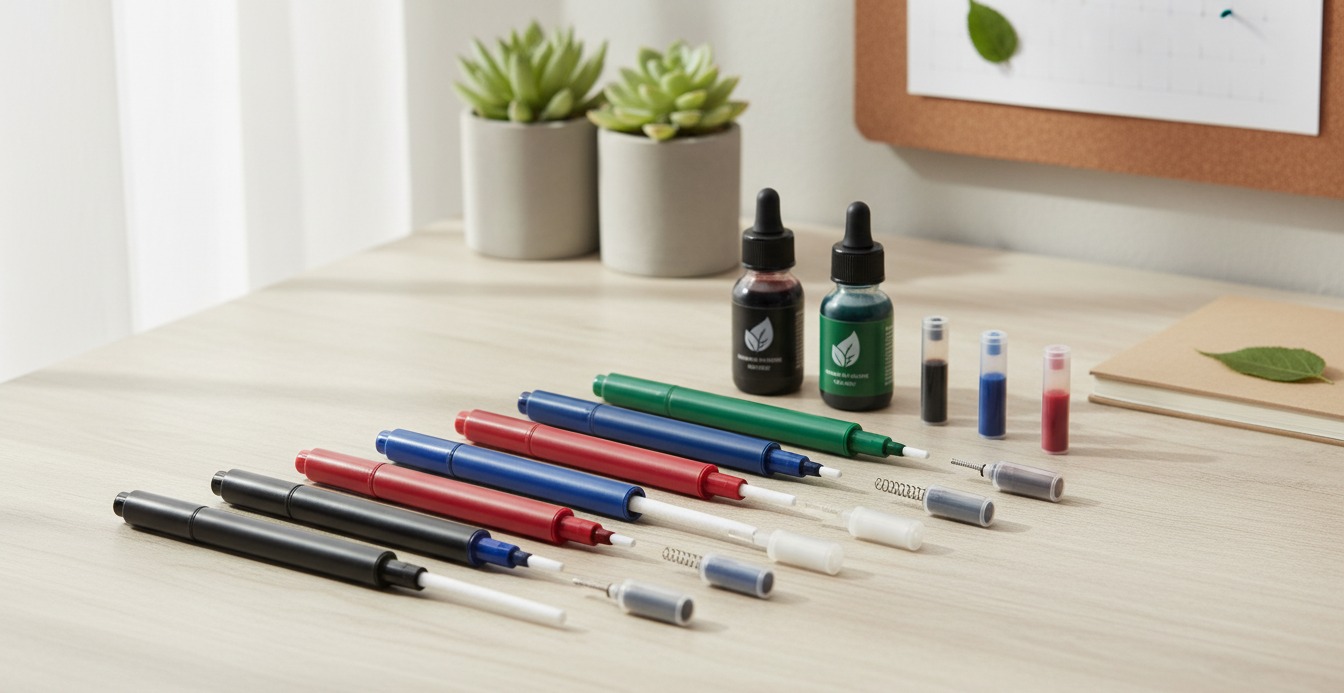
Recommended specification: 8-faceted barrel, maximum diameter 15 mm across flats, minimum wall thickness 0.8 mm in PP (polypropylene) or ABS plastic. PP is preferred for its resistance to the alcohol and glycol solvents commonly used in whiteboard ink formulations — ABS is more resistant to impact but is more susceptible to solvent stress cracking with prolonged ink contact. Twohands uses this design configuration, which also provides flat label surfaces for brand marking in three orientations.
Ink Performance: The Ghosting Problem
The number one complaint about whiteboard markers in office environments is ghosting — residual ink marks that remain after erasing, causing the board to accumulate a gray haze over weeks of use. Ghosting is caused by two independent mechanisms: ink drying into the microscopic pores of the whiteboard surface (particularly on melamine boards, which have a microporous surface), and the eraser leaving a thin film of ink residue behind that accumulates over repeated use cycles.
Ghosting is distinct from shadowing (a faint colored residue from dye components that have absorbed into the board surface) and from staining (permanent discoloration from pigments that have bonded chemically to the board coating). Ghosting from whiteboard markers can be removed with a wet cloth or board cleaner; staining requires board refinishing or replacement.
| Parameter | Standard Office Grade | Premium Low-Ghost Grade | Test Method |
|---|---|---|---|
| Ghosting index (after 30 days on melamine board) | < 15% haze | < 5% haze | Visual comparison with spectrophotometer |
| Dry erase time | 5–10 sec | 3–6 sec | ASTM D4464 (modified) |
| Erasure rate — single pass with felt eraser | ≥ 85% | ≥ 95% | Spectrophotometer reflectance reading |
| Cap-off life (before tip dries) | 2–4 hours | 8–24 hours | IART test standard |
| Ink volume per marker | 2.5–3.5 mL | 3.5–5.0 mL | Gravimetric fill check |
The premium low-ghost grade uses a release agent additive in the ink that prevents the pigment from bonding permanently to the whiteboard surface. The release agent is typically a fluorochemical surfactant that reduces the surface energy of the whiteboard coating, causing ink droplets to bead rather than spread into the microporous surface. Twohands’s wet erase marker formulation achieves 95%+ single-pass erasure on porcelain and glass whiteboards, with a cap-off life of 12+ hours.
Cap-off life is the duration a marker can remain uncapped before the nib dries out. The cap interior has an elastomeric seal (EPDM or silicone rubber) that creates a wiping seal against the nib tip. If this seal is defective or compressed permanently after repeated capping cycles, the cap-off life decreases dramatically — a marker that initially achieves 12-hour cap-off life may drop to 2–4 hours after 50 capping cycles. Distributors should request aging test data (cap-off life after 100 capping cycles) to verify long-term performance.
Ink Volume and Writing Length
Ink volume per marker (typically 2.5–5.0 mL for a standard chisel-tip whiteboard marker) is a major driver of both per-unit cost and writing length. Writing length is measured as the total linear distance of continuous 5 mm line width that can be written before the marker runs dry, and is typically 300–500 m for standard office grade markers and 400–700 m for premium high-capacity markers.
The relationship between ink volume and cost is approximately linear: increasing ink fill from 3.0 mL to 4.5 mL (a 50% increase) increases per-marker cost by approximately 15–20%, but the marker produces 45–50% more writing length. This makes the premium ink fill a cost-effective option for high-usage environments such as schools and call centers.
Bulk Pricing Structure for Office Distributors
Whiteboard markers with magnetic caps are typically priced in three volume tiers:
| Volume Band | Unit Price (4-Color Set) | Unit Price (Bulk Box of 48) | Per-Marker Cost | Packaging | Lead Time |
|---|---|---|---|---|---|
| 1,000–5,000 sets | $2.20–2.80 | $24.00–30.00 | $0.50–0.63 | Blister card or polybag | 3–4 weeks |
| 5,000–20,000 sets | $1.60–2.00 | $18.00–22.00 | $0.38–0.46 | Display box (48/display) | 4–5 weeks |
| 20,000+ sets | $1.20–1.50 | $14.00–17.00 | $0.29–0.35 | Bulk carton + display (negotiable) | 5–7 weeks |
Pricing assumes standard 4-color set (black, blue, red, green) or 48-piece bulk box (any color mix), with magnetic cap and anti-roll faceted barrel. Custom colors and branded barrel printing increase per-unit cost by 15–25% depending on volume. Twohands’s full product catalog includes additional whiteboard marker configurations, including chisel-tip and fine-point variants.
Packaging and Display Options
Office accessory distributors typically require two packaging tracks:
- Retail blister card: 4-color set on a fold-over card with a clear PET blister. SKU-compatible with standard pegboard hooks. Back panel includes color swatch, writing sample, and product features (magnetic cap, anti-roll, low-ghost ink, 8-hour cap-off).
- Bulk box (48 pieces): Corrugated box with a perforated front panel for quick opening. Each marker is individually bagged or organized in a plastic tray insert. The bulk box functions as both shipping container and countertop display for office supply stores.
Custom packaging options through Twohands’s OEM program include branded barrel printing (up to 4-color offset or pad printing), custom cap color matching, and POS display design for office supply retailers.
Industry references: ASTM F2738 covers the performance requirements for dry-erase markers, including writing performance, erasability, and cap retention. The American Association of School Administrators (AASA) Office Supply Guidelines provides industry-standard product category codes and packaging guidelines for office supply distribution.
Conclusion
For office accessory distributors, whiteboard markers with magnetic caps occupy a growing subcategory driven by the open-office trend where whiteboard surfaces double as room dividers and the marker needs to be stored on the board itself. The key specifications to specify are magnet grade (NdFeB N35 minimum), anti-roll geometry (8-faceted barrel), and ink ghosting index (under 5% for premium positioning). Bulk pricing at the 5,000–20,000 unit band provides the best per-unit cost for most regional distributors.
Twohands produces whiteboard markers with magnetic caps, anti-roll barrel, and low-ghost ink formulation across both retail and bulk packaging formats.
WENDY — Twohands Company Manager
Twohands Stationery is a professional manufacturer and innovator in the stationery industry, dedicated to producing a wide range of high-quality pens. Since its establishment in 2010, we have built an excellent reputation for reliability and become a trusted partner of many well-known global brands.
TikTok: @Twohands | YouTube: CICOR Pen | Instagram: @cicorcicor93 | Facebook: CICOR Acrylic Marker
Twohands offers bulk pricing, custom barrel branding, and retail-ready packaging for distributors.
Request Bulk Quote →
Post time: Jun-03-2026
