
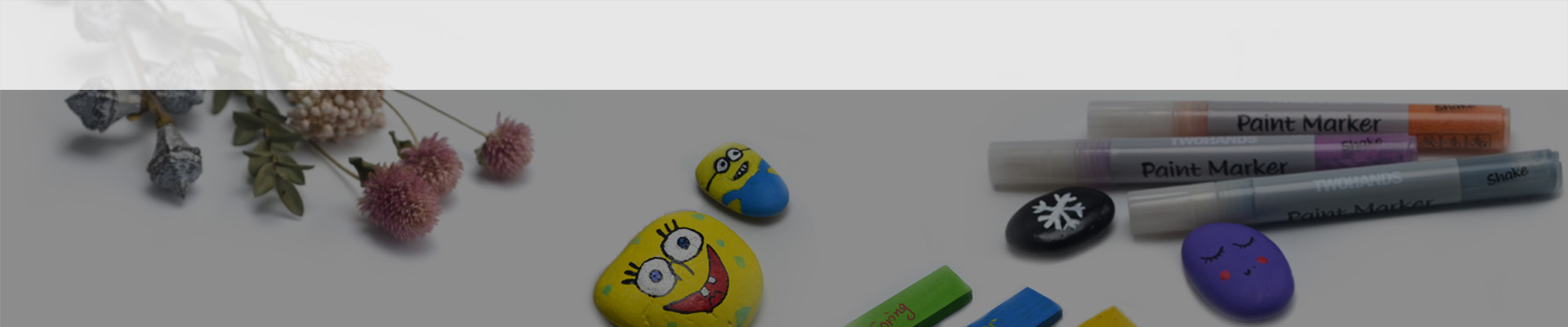
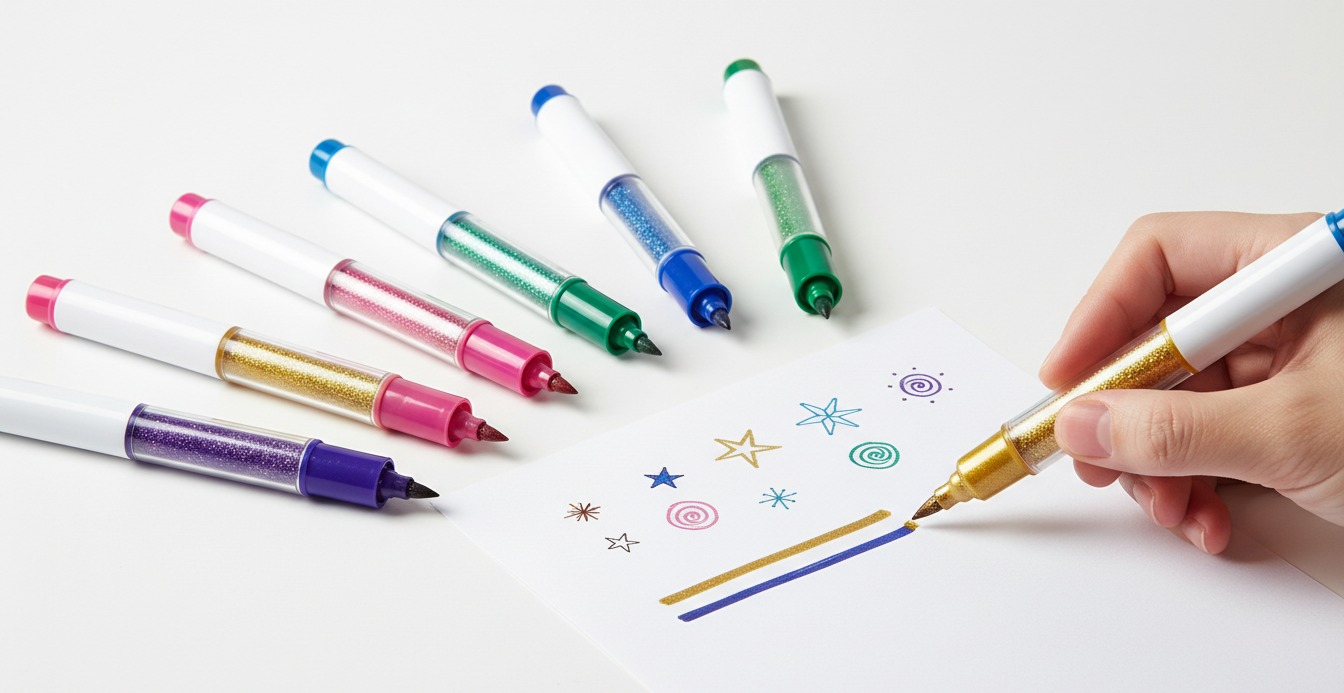
Twohands Stationery — a professional marker and pen manufacturer established in 2010, with an established reputation for reliability in the global art supply market — produces outline marker pens including the Dream Double-Line Outline Marker series. Their experience across standard and OEM custom orders provides the reference case for understanding how to qualify and order outline marker pens from Chinese manufacturers.
The Double-Line Ink Technology Problem: Why Standard Marker Specifications Do Not Apply
A standard marker pen has one ink channel feeding one nib — the specification for ink viscosity, flow rate, and nib absorption is well-established and broadly understood. An outline marker pen has two ink channels that must feed two parallel nibs simultaneously, depositing two lines of consistent width and spacing while maintaining independent ink flow to each nib. The engineering challenges in achieving consistent dual-line deposition across 10,000 units are meaningfully different from single-channel marker production: the spacing between the two nibs must be maintained precisely across the marker’s mechanical assembly; the ink flow to each channel must be balanced to prevent one line from running dry before the other; the ink formulation must be identical in both channels (or deliberately differentiated if the two lines are different colors); and the valve mechanism must control two independent flows without cross-channel interference. A manufacturer who makes standard markers well is not automatically qualified to make outline markers well — the technology transfer is not automatic.
Double-Line Ink System Technology: How It Works
The Dual-Channel Feed Mechanism
The defining mechanical feature of an outline marker pen is the dual-channel feed system that delivers ink to two parallel nibs simultaneously. There are two common mechanical implementations:
- Finned dual-slot nib design: The nib is a single piece of fiber or felt with a central fin that physically separates the two ink channels within the nib body, maintaining separation from the reservoir to the substrate. This design is mechanically simpler and less prone to cross-channel leakage but requires precise nib manufacturing tolerances
- Dual-tube reservoir with bifurcated nib holder: Two separate ink chambers in the barrel feed two separate nibs through a bifurcated (Y-shaped) feed channel. This design allows different ink colors in each line but requires more precise assembly to prevent leakage at the bifurcation point
For most art supply applications — where both lines are the same color and the objective is a consistent outline — the finned dual-slot nib design is the standard implementation. The critical specification is the nib spacing: the distance between the centers of the two ink channels at the substrate contact point.
Nib Spacing: The Specification That Determines Product Quality
The nib spacing in an outline marker determines the visual character of the outline — too narrow and the two lines merge into a single thick line; too wide and the outline area between the lines becomes impractically large for detailed work:
| Nib Spacing | Visual Effect | Best Application |
|---|---|---|
| 2–3mm | Narrow double outline; lines appear as a single thick line from a distance | Fine detail work; small-scale illustration |
| 4–5mm | Classic outline width; clearly two parallel lines with a fill area between | General illustration; coloring book outlines; bullet journaling |
| 6–8mm | Wide outline; pronounced border effect | Decorative applications; signage; large-format coloring |
The nib spacing tolerance — the allowable deviation from the nominal spacing — is the critical quality parameter. A quality outline marker maintains nib spacing within +/- 0.3mm across the production run. If the manufacturer’s tolerance is wider, a meaningful percentage of units will have inconsistent spacing that is visible to the end user and generates complaints.
Ink Formulation Requirements for Dual-Channel Systems
The ink in an outline marker must meet all the requirements of a standard marker ink — lightfastness, adhesion, dry time — plus additional requirements specific to dual-channel delivery:
- Identical flow characteristics in both channels: If the ink flows differently in channel A vs. channel B (due to viscosity difference, pigmentation difference, or absorption rate difference), the two lines will have visibly different characteristics — one darker or more saturated than the other
- No cross-channel migration: The ink formulation must not wick laterally across the nib fin or at the bifurcation point — cross-channel ink migration causes the two lines to bleed together and defeats the purpose of the dual-line design
- Consistent re-saturation: When the user lifts the pen and returns to drawing, both nibs must re-saturate at the same rate — if one nib re-saturates faster than the other, the user experiences alternating line quality as they draw
- Anti-clogging formulation: The fine channels in the nib (typically 0.3–0.6mm hydraulic diameter) require ink with carefully controlled particulate content — pigment particle size must be below 3 microns to prevent channel clogging
Verifying Outline Marker Manufacturing Quality Before the 10,000-Unit Order
Technical Due Diligence Checklist
Outline Marker Technology Verification: What to Request from the Manufacturer
- Nib spacing specification and tolerance: Request the engineering drawing showing nib spacing, and request the production tolerance specification — quality manufacturers will have +/- 0.3mm or tighter
- Nib spacing test data from recent production batches: Request a Cpk or similar process capability index for the nib spacing measurement — a Cpk of 1.33 or above indicates a process in good statistical control
- Channel flow balance test: Request the manufacturer’s test method for verifying flow balance between the two channels — there should be a defined test protocol using a standardized substrate and drawing length
- Ink formulation data: Request MSDS and TDS for the outline marker ink formulation, including pigment particle size data (should be below 3 microns)
- Sample consistency test: Draw test marks from 20 sample pens from the same production batch; measure nib spacing on each and calculate the standard deviation — this tells you the actual production consistency before you commit
- Re-saturation test: Draw a continuous 50cm line, pause for 10 seconds, resume drawing; observe whether the re-saturation produces consistent line quality
- Cross-channel migration test: Draw multiple parallel lines in quick succession; examine whether the lines show bleeding at the nib spacing that increases with drawing speed
What Good Looks Like: Physical Sample Evaluation
Beyond specification documents, evaluate the physical samples the manufacturer provides:
- Line consistency across the stroke: Both lines should maintain consistent width and saturation from first contact to the end of the stroke — unless the marker is nearly empty
- Parallelism: The two lines must be genuinely parallel — not converging or diverging as the mark is drawn. Diverging or converging lines indicate nib spacing that changes under writing pressure
- Line gap uniformity: The space between the two lines should be visually consistent throughout the stroke
- No bleeding between lines: The two lines should have a clean, sharp boundary with no ink bleeding into the gap between them
- Nib spread under pressure: Apply firm writing pressure and observe whether the nib spacing changes — a well-designed outline marker maintains spacing under normal writing pressure variations
The 10,000-Unit OEM Order: Structure, Cost, and Timeline
Typical OEM Order Structure for Outline Marker Pens
| Order Element | Typical Specification | Notes |
|---|---|---|
| MOQ per color | 2,000–3,000 units per color | Lower for standard catalog colors |
| MOQ for custom color | 3,000–5,000 units per custom color | Includes ink matching and approval cycle |
| Production lead time | 6–10 weeks from sample approval | Custom packaging adds 2–3 weeks |
| Tooling / die cost | $800–$2,500 for custom barrel mold | One-time cost; amortized or quoted separately |
| Sample approval cycle2–3 rounds of samples before production approval | Each round 2–3 weeks |
Typical OEM Pricing for Outline Marker Pens
Factory-direct OEM pricing for outline marker pens (FOB China, 10,000-unit order) depends on quality level and customization:
- Budget quality (trading company standard): $0.35–$0.55 per pen
- Standard quality (established manufacturer): $0.55–$0.85 per pen
- Premium quality (full quality verification, premium nib): $0.85–$1.40 per pen
The premium quality pricing is justified by lower return rates, higher retail customer satisfaction, and the ability to command a higher retail price point — a premium outline marker at $2.50–$4.00 retail per pen vs. a budget marker at $1.00–$1.50 retail per pen generates materially better distributor margin even at a higher unit cost.
Sample Approval Cycle: The Step You Cannot Skip
Before placing the 10,000-unit production order, the sample approval cycle is non-negotiable. Expect:
- First sample (proto): Initial production run of 50–100 units for basic specification verification — confirms nib spacing, ink color, and barrel fit
- Second sample (pilot): Refined production based on first sample feedback — addresses first sample issues
- Pre-production sample (PPAP equivalent): Final production-run sample for formal approval — confirms the production process is ready and the product meets the approved specification
- Top-of-production sample: First units off the production line, compared against the approved pre-production sample — confirms production consistency
Each sample round typically takes 2–3 weeks including shipping. The total sample cycle time of 6–9 weeks before production is a fixed cost of the development process — do not compress it by skipping sample rounds. The cost of re-tooling after production has begun, or of receiving a production batch that does not meet specification, far exceeds the cost of an extra sample round.
Procurement Checklist: Outline Marker Pen OEM Qualification
- Confirm the manufacturer has specific outline marker production experience — not just general marker manufacturing
- Request nib spacing engineering drawings and production tolerance specifications — the tolerance is your quality guarantee
- Request flow balance test data for the dual-channel ink system
- Test physical samples from recent production batches: line consistency, parallelism, nib spacing under pressure, re-saturation behavior
- Request ink formulation data: pigment particle size, MSDS, and lightfastness rating for each color
- Verify nib spacing consistency across 20+ sample units — calculate standard deviation to understand production consistency
- Request the manufacturer’s outline marker defect rate from recent production batches
- Clarify the sample approval cycle: number of sample rounds, timeline per round, and what constitutes approval
- Negotiate tooling cost as a separate line item — do not allow tooling costs to be hidden in the per-unit price
- Establish payment terms: 30% deposit against confirmed order, 70% against shipping documents or sample approval
- Define the quality acceptance criteria in the purchase agreement: acceptable defect rate, inspection method, and non-conformance resolution process
- Consider third-party pre-shipment inspection for the 10,000-unit production run — a 2–3 day inspection at the factory costs $300–$600 and verifies what you are shipping before it arrives
Need an Outline Marker Pen Manufacturer for Your OEM Program?
Twohands Stationery — a professional marker and pen manufacturer established in 2010 — produces outline marker pens including the Dream Double-Line Outline Marker series, serving art supply distributors and well-known global brands worldwide. Twohands supports OEM custom outline marker orders including custom nib spacing specifications, custom ink colors, custom barrel and packaging design, and private label branding. For OEM inquiry, technical specification support, or sample evaluation, contact Twohands Stationery with your outline marker requirements. Browse the full marker range including all Twohands Stationery products for wholesale and OEM orders.
Frequently Asked Questions
Q1: What is a realistic defect rate for quality outline marker pen production from a Chinese manufacturer?
For a quality manufacturer with established outline marker production experience, a defect rate of 0.5–1.5% is typical — meaning 50–150 units out of 10,000 will have some form of defect. The most common defects in outline marker production: nib spacing outside tolerance (typically 0.3–0.8% of production); ink flow imbalance between channels (0.2–0.5%); leaking at the barreljoint or cap seal (0.1–0.3%); and cap seal failure causing dry-out (0.2–0.5%). A defect rate above 2% suggests the manufacturer does not have adequate quality control for outline marker production specifically. Negotiate the acceptable defect rate into the purchase agreement and specify whether defects are defined as functional failures only or include cosmetic defects.
Q2: How do I specify the nib spacing for an outline marker pen for the coloring book market vs. the fine art market?
For coloring book and general illustration applications, specify 4–5mm nib spacing — this is the classic outline width that leaves a comfortable fill area for coloring between the lines. For fine art and bullet journaling applications, 2–3mm spacing is more appropriate — the narrower lines allow more detailed work. For decorative and signage applications, 6–8mm provides a bold outline effect. Always request physical samples with your target application substrate (paper type, weight, surface coating) — nib spacing perception varies significantly with substrate texture and absorbency.
Q3: Can an outline marker pen manufacturer produce different colors in each of the two lines?
Yes — if the manufacturer uses the dual-tube reservoir with bifurcated nib holder design, two different ink colors can be loaded in each channel. This is technically feasible but significantly increases the production complexity and the per-unit cost. A dual-color outline marker requires two independent ink filling operations, and the risk of cross-channel contamination during assembly is higher. MOQ for a dual-color outline marker is typically 3,000–5,000 units per color combination. Most art supply distributors use the same color in both lines and achieve the outline effect purely through the nib spacing geometry.
Q4: How do I verify that the nib spacing tolerance is actually being maintained in production?
The most reliable method is to request production samples and measure them yourself: take 20–30 pens from the sample batch, draw test marks on white paper, measure the nib spacing on each mark using a digital caliper or microscope with measurement function, and calculate the standard deviation. If the standard deviation is 0.3mm or less, the production process is tightly controlled. If it exceeds 0.5mm, the manufacturer’s tolerance specification is not being maintained in practice. You can also request the manufacturer’s in-process inspection records showing the measurement data from the production run — a quality manufacturer maintains these records and will share summary data.
Q5: What is the typical timeline for a 10,000-unit OEM outline marker pen order from sample approval to delivery?
Typical timeline: sample approval (2–3 rounds, 4–8 weeks total) + production (6–10 weeks from sample approval) + shipping (sea freight 4–6 weeks to European or North American destination). Total from initial sample request to delivery: 14–22 weeks. If custom packaging is involved, add 2–3 weeks to the sample approval and production timeline. Build this timeline into your product development calendar — the worst-case outcome is a 10,000-unit order that arrives 8 weeks after your target retail window, requiring discount pricing or missed seasonal sales.
Twohands Stationery is a professional manufacturer and innovator in the stationery industry, dedicated to producing a wide range of high-quality pens and markers. Since its establishment in 2010, Twohands has built an excellent reputation for reliability and become a trusted partner of many well-known global brands. Writing, drawing, creating — choose Twohands Stationery to meet your writing and drawing needs. TikTok | YouTube | Instagram | Facebook
Post time: May-26-2026
