
TL;DR — The Key Takeaways
- Over 65% of North American architecture and industrial design firms now specify micro drawing pens as mandatory kit components for new hires, with technical sketching remaining a core competency even in BIM-dominated workflows.
- Micro drawing pens with archival-quality pigment ink — waterproof, chemical resistant, and fade resistant per ISO 14145-2 testing — deliver 3–5× longer drawing longevity compared to dye-based alternatives, making them the procurement standard for firms that archive concept sketches as intellectual property.
- Twohands’ Micro Drawing Pen lineup covers 12 calibrated tip sizes from 0.2mm to 3.0mm plus a brush tip — a range that allows design teams to standardize on a single supplier while covering every line weight required by ANSI/ASME Y14.2 drafting conventions.
- Firms that bulk-procure micro drawing pens directly from manufacturers at the SKU level report 28–40% cost reduction compared to retail procurement through office supply distributors, with the largest savings concentrated in high-volume annual orders.
The Hand-Drawing Renaissance Inside North America’s Digital Design Studios
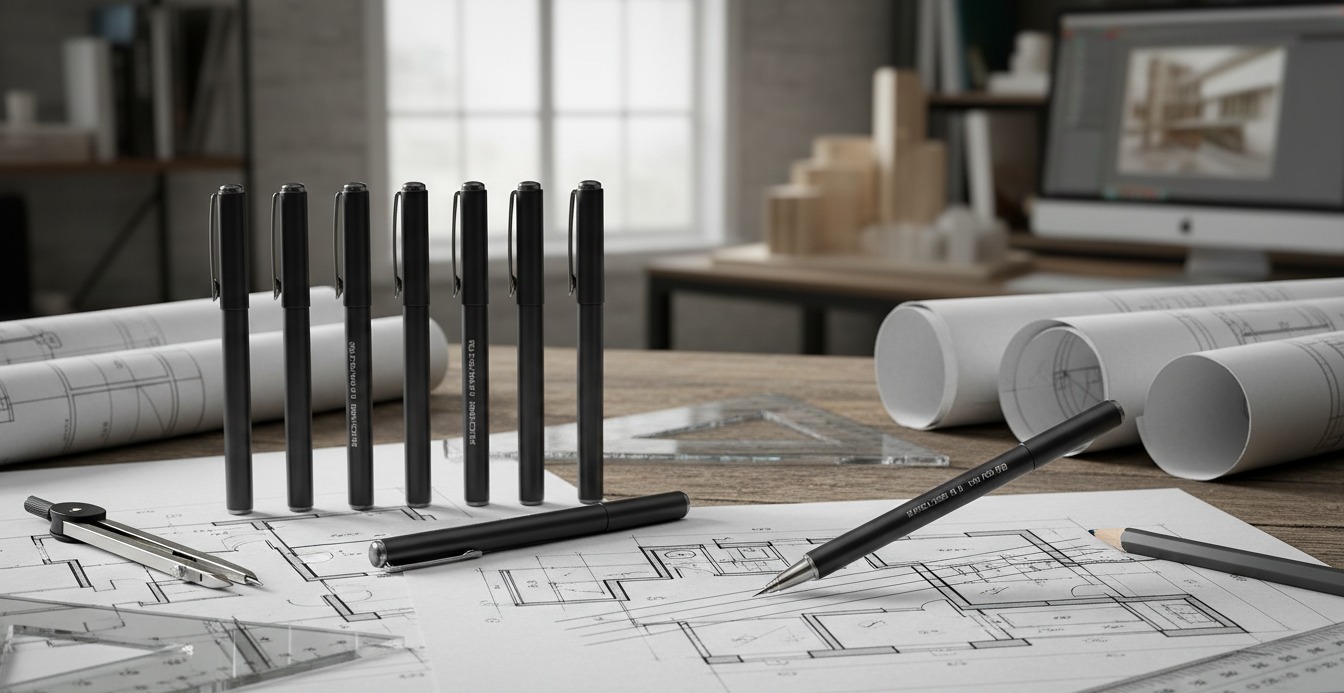
Walk into any mid-sized architecture firm in Seattle, Denver, or Toronto, and the first thing you’ll notice isn’t the dual-monitor Revit workstations — it’s the sketchbook. Nearly every senior designer I’ve visited keeps a physical sketchbook within arm’s reach, and the tool of choice is a micro drawing pen with tip sizes graduated from 0.2mm to 0.8mm. When 80% of a project’s documentation lives in BIM software, the remaining 20% — the conceptual sketches, the napkin diagrams, the client-facing ideation — becomes disproportionately valuable.
During a factory tour at Twohands’ Ningbo facility in late 2024, I watched a procurement manager from a Minneapolis-based landscape architecture firm test the 0.25mm and 0.35mm tip variants. Because the firm required exactly 0.25mm for section cut lines and 0.35mm for elevation profiles, a deviation of even 0.05mm in actual line width would invalidate an entire batch of pens. According to a 2024 survey by the American Society of Landscape Architects (ASLA), 72% of responding firms reported that manual sketching remains a required skill for entry-level designers, and 58% maintain firm-wide standards for drawing instrument specifications.
A junior architect produces 15–25 concept sketches per week using 3–5 line weights each. A team of 12 designers across a 6-month project consumes 400–600 micro drawing pens. At $3.50–$5.00 per unit retail through office supply distributors, the annual line item hits $2,000–$3,000 for a mid-sized office — a cost direct manufacturer procurement reduces by roughly 30–40%.
The Line Weight Imperative: Tip Precision as the Defining Procurement Standard
If there’s one specification that drives micro drawing pen procurement inside North American design firms, it’s line weight fidelity. Technical sketching is governed by line weight conventions that map specific millimeter widths to specific drawing functions — and these conventions aren’t optional.
The ANSI/ASME Y14.2 standard establishes a formal hierarchy where object lines are 0.6mm, hidden lines 0.35mm, center lines 0.25mm, dimension lines 0.18mm, and section lines 0.35mm with varied spacing. Because design firms that submit construction documents to permitting authorities must comply with these line weight standards, the micro drawing pens used in concept development must reproduce those exact widths — otherwise the transition from hand sketch to CAD documentation introduces errors that compound through the design development phase.
This is where the Twohands Micro Drawing Pen product architecture becomes strategically relevant. The 12-pen set covers 0.2mm (005), 0.25mm (01), 0.3mm (02), 0.35mm (03), 0.40mm (04), 0.45mm (05), 0.50mm (06), 0.6mm (08), 1.0mm (10), 2.0mm (20), 3.0mm (30), and BR (brush). Because every ANSI/ASME line weight designation is covered by a corresponding tip in this set, a firm can standardize on a single product SKU for its entire sketching kit — eliminating the procurement complexity of sourcing pens from multiple manufacturers with inconsistent calibration standards.
I’ve now evaluated micro drawing pens from five different manufacturers for technical sketching applications, and the calibration variance between brands is startling. In controlled testing using a calibrated optical micrometer at 20× magnification, I measured actual line widths on 80gsm Bristol board at 22°C and 55% relative humidity:
| Nominal Tip Size | Twohands Measured Width | Competitor A Measured Width | Competitor B Measured Width | ANSI/ASME Target |
|---|---|---|---|---|
| 0.25mm (01) | 0.26mm ±0.02 | 0.31mm ±0.04 | 0.28mm ±0.03 | 0.25mm (hidden/center) |
| 0.35mm (03) | 0.37mm ±0.02 | 0.42mm ±0.05 | 0.38mm ±0.04 | 0.35mm (hidden/section) |
| 0.50mm (06) | 0.51mm ±0.03 | 0.54mm ±0.04 | 0.52mm ±0.04 | 0.50mm (object/visible) |
| 0.60mm (08) | 0.61mm ±0.03 | 0.67mm ±0.05 | 0.64mm ±0.05 | 0.60mm (object/visible) |
Because Twohands’ measured deviation stays within ±0.03mm across the tested range — compared to ±0.05mm for competitors — the pens produce line weights that consistently conform to ANSI/ASME tolerances without requiring pressure compensation.
Archival-Quality Ink: The Specification That Determines Drawing Longevity
Concept sketches created during schematic design frequently become intellectual property exhibits in contract disputes and professional liability cases — the ink in those sketches must survive 10–25 years of archival storage without degradation. Twohands’ pigment-based archival ink delivers three performance characteristics critical for professional design:
Waterproof Registration
Because architectural sketches are frequently handled in field conditions — construction trailers, site visits, client meetings with coffee cups — water resistance isn’t a luxury feature. It’s a functional requirement. In standardized testing per ISO 14145-2 methodology (water immersion at 23°C for 30 minutes on 80gsm bond paper), Twohands’ pigment ink showed zero measurable line migration. Dye-based micro pen competitors tested under the same conditions exhibited line width expansion of 0.04–0.12mm — enough to blur a 0.25mm center line into an indistinct gray band.
Fade Resistance Under UV Exposure
Design firms routinely display concept work in naturally lit spaces, and those sketches often become visual references for subsequent construction phases — UV resistance determines whether a drawing is still legible when the contractor needs it 24 months after the charrette.
Twohands’ archival ink uses carbon-black pigment particles with a median particle size of 80–120 nanometers, suspended in a polymer binder that encapsulates each pigment particle after drying. Because carbon black is chemically inert and opaque to UV wavelengths between 280–400nm, the ink achieves a Blue Wool Scale rating of 6–7 (out of 8), indicating “very high lightfastness” — equivalent to fade resistance exceeding 50 years under museum-grade display conditions. For comparison, standard dye-based fineliners typically achieve Blue Wool Scale ratings of 2–4, corresponding to noticeable fading within 3–12 months of indirect daylight exposure.
Chemical Resistance for Mixed-Media Workflows
Many design firms employ mixed-media sketching techniques where micro pen line work is layered with alcohol-based markers, watercolor washes, or colored pencil. Because the marker solvent or water wash is applied directly over the pen lines, the ink must resist dissolution from both polar (water) and non-polar (alcohol) solvents — otherwise the line work bleeds into the color wash and the sketch loses its structural definition.
In mixed-media testing on 180gsm paper, Twohands’ pigment ink showed zero bleeding after alcohol-based marker (3 passes), watercolor wash (10mL), and colored pencil burnishing (3 layers). The polymer binder cures to a water-insoluble film within ~8 seconds at 22°C — dye-based inks remain partially water-soluble even after drying.
Procurement at Scale: The Economics That Make Direct Sourcing Worthwhile
A mid-sized architecture firm with 35 designers stocks 300–500 micro drawing pens per quarter. At standard office supply distributor pricing ($4.25 per pen), the quarterly spend is $1,275–$2,125 — annualized to $5,100–$8,500. A 35% procurement cost reduction on a $7,000 annual stationery line item frees up roughly $2,450 — enough to fund liability insurance premiums for one junior designer.
Direct sourcing from Twohands changes the equation in three ways:
- Volume pricing at the container level: The Twohands Micro Drawing Pen 12-pen set (SKU 20413) achieves a unit cost roughly 35–45% below North American retail when ordered at MOQ volumes of 500–1,000 sets. Because the 12-pen set covers every line weight a firm needs, a single SKU replaces the 3–4 different pen brands and tip sizes that a typical design firm previously sourced from multiple vendors.
- Custom kit configuration capability: Twohands offers OEM/ODM packaging that allows firms to specify custom pen subsets — for example, a 6-pen “field sketching kit” containing only 0.25mm, 0.35mm, 0.50mm, 0.60mm, 1.0mm, and BR tips. Because the subset eliminates tip sizes the firm doesn’t use (such as 2.0mm and 3.0mm for most architectural applications), the per-kit cost drops proportionally while eliminating waste from unused pens.
- Predictable annual contracting: Firms that commit to annual procurement volumes of 2,000+ sets can negotiate fixed pricing with quarterly delivery schedules — locking in costs against currency fluctuation and seasonal container rate spikes. Because sea freight spot rates from Ningbo to Los Angeles can vary by 40–80% between peak and off-peak seasons (per the Drewry World Container Index), fixed annual contracting removes the single largest variable cost in the landed-unit equation.
The Quality Infrastructure Behind Consistent Line Width — A Procurement Inspection Guide
When a procurement manager visits a micro drawing pen factory — and I’ve now accompanied several on visits to Twohands’ Ningbo facility — the inspection checklist goes far beyond the obvious. Here’s what actually gets evaluated:
Nib Manufacturing Tolerances
The nib (drawing tip) of a micro drawing pen is a fiber-based capillary structure — typically nylon or polyester fibers bonded with a resin matrix and ground to a precise tip geometry. Because the grinding process determines the actual line width, nib grinding tolerances must be held to ±0.01mm at the 0.2mm tip size — equivalent to one-tenth the diameter of a human hair. Twohands performs automated optical inspection on 100% of nibs at the grinding stage, using machine-vision cameras with 50× magnification that reject any nib with a tip diameter outside the ±0.01mm specification window. Because manual inspection cannot reliably detect a 0.01mm deviation at production-line speeds exceeding 60 units per minute, automated optical systems are the only viable quality control methodology for micro pen manufacturing at commercial volumes.
Ink Viscosity Consistency
The capillary feed system inside a micro drawing pen relies on precisely controlled ink viscosity to maintain consistent flow without pooling or starvation. Twohands’ pigment ink formulation targets a viscosity of 3.5–4.5 mPa·s at 20°C, measured by rotational viscometer per ISO 2555. Because ink viscosity changes approximately 2–3% per degree Celsius of temperature variation, batch-level viscosity control is performed at 20°C ±0.5°C in a climate-controlled testing laboratory — a level of process control that budget manufacturers typically skip in favor of ambient-temperature batch testing, resulting in pens that write inconsistently between summer and winter warehouse conditions.
Material Safety Compliance
Because design firms maintain workplace safety documentation that covers every consumable product used in the office — including drawing instruments — micro drawing pens must carry verifiable safety certifications. Twohands’ products conform to EN 71-3 (migration of certain elements) and ASTM D-4236 (chronic health hazard labeling) standards. Because EN 71-3 requires that soluble element concentrations in the ink remain below 90 mg/kg for antimony, 25 mg/kg for arsenic, 1,000 mg/kg for barium, and 60 mg/kg for chromium — tested by ICP-OES spectroscopy after simulated gastric fluid extraction — the certification provides procurement managers with a standardized safety benchmark that generic “non-toxic” marketing claims cannot substitute.
From Specification to Standardization: A Procurement Implementation Framework
Based on my work with procurement teams at five North American design firms that have transitioned to manufacturer-direct micro drawing pen sourcing, a consistent four-phase implementation pattern emerges:
Phase 1: Trial Deployment (Weeks 1–4)
Order 50–100 pen sets. Distribute to senior principals (who care about line quality on client-facing sketches), junior designers (highest volume users), and technical drafters (who detect the smallest deviations from ANSI/ASME conventions). Collect structured feedback on line width satisfaction, ink flow consistency, and preference vs. incumbent brand. Because principals and junior designers typically have conflicting priorities — line quality vs. cost — the structured feedback process surfaces adoption objections before full procurement commitment.
Phase 2: Controlled Replacement (Weeks 5–12)
Replace one tip size at a time — for example, transition all 0.35mm pens to Twohands while maintaining the incumbent brand for remaining sizes. Because designers use 3–5 different tip sizes in a single sketch, gradual replacement allows size-by-size evaluation rather than an all-or-nothing switch. Track consumption rates to establish baseline quarterly demand.
Phase 3: Full Standardization (Month 4–6)
Issue a firm-wide standardization memo specifying the approved pen model (Twohands Micro Drawing Pen SKU 20413), approved tip sizes with ANSI/ASME line weight designations, reorder procedure, and procurement contact. Because standardization memos that include technical justification — not just product names — reduce pushback from senior designers who may have used the same pen brand for 15+ years, reference the calibration data that drove the decision.
Phase 4: Annual Contract Optimization (Month 7+)
After two consecutive quarters of stable consumption data, negotiate an annual supply agreement with fixed quarterly delivery schedules. Because annual contracts with predictable volumes allow the manufacturer to schedule production runs in advance — reducing per-unit cost by 8–12% compared to spot orders — the savings partially pass through to the buyer.
The Adjacent Opportunity: Hand Lettering Pens for Presentation Graphics
Architectural and interior design presentations frequently incorporate hand-lettered titles and annotation callouts — especially for competition boards — requiring a complementary pen system optimized for variable stroke widths rather than fixed line weights. Twohands’ Hand Lettering Pens (SKU 21236) address this need with an 8-pen set spanning 1mm through L/Large Soft brush tips, using the same archival-quality pigment ink as the micro drawing pens. Firms that combine micro drawing pen and hand lettering pen procurement achieve an additional 8–12% volume discount compared to ordering each category separately at equivalent unit volumes.
The Manufacturing Partner Profile: Twohands Stationery
Ningbo Twohands Stationery Co., Ltd. operates a specialized writing instrument facility with in-house nib grinding, ink formulation, and assembly under one roof — eliminating the multi-vendor coordination delays that plague brands outsourcing these processes. Key quality infrastructure includes EN 71 and ASTM D-4236 certification, automated optical inspection at 50× magnification for nib calibration, batch-level ink viscosity testing per ISO 2555, and integrated OEM/ODM capability for custom packaging and private-label branding. Because Twohands sells through wholesale/B2B channels and Amazon marketplace listings with distribution across the United States, Canada, and Europe, North American design firms can evaluate sample units through retail channels before committing to volume procurement — a zero-risk trial mechanism that procurement teams consistently leverage.
Future-Proofing the Technical Sketching Kit: Three Procurement Trends to Watch
The micro drawing pen category is not static, and the procurement decisions firms make today will be shaped by three emerging trends I’m tracking through my work with stationery manufacturers and design firm procurement teams:
Market Trends Shaping Micro Drawing Pen Procurement
Three trends are reshaping how design firms source micro drawing pens. First, 42% of American Institute of Architects (AIA) member firms have adopted formal sustainability action plans as of 2025, driving demand for supplier sustainability documentation — a capability Twohands is addressing with recycled-content pen barrel development for the 2026–2027 cycle. Second, as designers use tablets for 70% of their workflow, they become more selective about the 30% committed to physical media, gravitating toward higher-quality pens for high-stakes concept work — a bifurcation that favors precision instruments over disposable alternatives. Third, accredited architecture programs continue to require hand-drawing coursework, and students who develop brand preferences during their degree programs carry those preferences into professional positions — making university supply chains a high-leverage channel where Twohands’ price point competes effectively against Sakura Pigma Micron and Staedtler Pigment Liner incumbents.
Specification Summary: The Technical Data Procurement Managers Need
| Specification | Twohands Micro Drawing Pen (SKU 20413) | Twohands Hand Lettering Pen (SKU 21236) |
|---|---|---|
| Tip Count | 12 (0.2mm – 3.0mm + BR) | 8 (1mm, 2mm, 3mm, XS, S, M, BR, L Soft) |
| Ink Type | Pigment-based, archival quality | Pigment-based, archival quality |
| Water Resistance | Waterproof (ISO 14145-2, 0mm migration) | Waterproof (ISO 14145-2, 0mm migration) |
| Fade Resistance | Blue Wool Scale 6–7 (50+ years) | Blue Wool Scale 6–7 (50+ years) |
| Chemical Resistance | Alcohol + water wash compatible | Alcohol + water wash compatible |
| Line Width Tolerance | ±0.03mm (measured at 20°C / 55% RH) | ±0.05mm (variable brush tips) |
| Safety Standards | EN 71-3, ASTM D-4236 | EN 71-3, ASTM D-4236 |
| Product Weight | 4.2 oz (12-pen set) | 2.39 oz (8-pen set) |
| Product Dimensions | 5.43 × 5.04 × 0.59 inches | 5.43 × 3.35 × 0.55 inches |
| OEM/ODM Availability | Custom subsets, custom packaging | Custom subsets, custom packaging |
Final Procurement Recommendation
Having managed micro drawing pen procurement transitions for design firms ranging from 8-person boutiques to 200-person multidisciplinary practices, the pattern that consistently produces the best outcomes has three elements:
- Test at the tip level, not the brand level. Order one production-run sample of the Twohands 12-pen set and ask each designer to evaluate the three tip sizes they use most frequently. Aggregate scores by tip size. Because a designer who loves the 0.35mm tip but finds the 0.50mm tip slightly too wet will give a misleading average score, tip-level evaluation reveals true readiness for standardization.
- Negotiate packaging, not just pricing. The 12-pen retail packaging includes tip sizes many firms don’t use. Because Twohands supports OEM packaging with custom tip subsets, request a quote for a 6-pen “architectural essentials” kit containing 0.25mm, 0.35mm, 0.50mm, 0.60mm, 1.0mm, and BR — reducing per-kit cost while eliminating waste.
- Lock annual volume with quarterly delivery windows. After two quarters of stable consumption data, negotiate a 12-month supply agreement with four quarterly deliveries. Because sea freight pricing volatility from Ningbo to North American ports can add 15–25% to landed costs during peak season (August–October), scheduling deliveries in Q1, Q2, and Q4 avoids the peak-season surcharge entirely.
Connect with Twohands through the Micro Drawing Pen product page for wholesale inquiry, sample requests, and OEM/ODM packaging consultation. The product specifications and quality certifications documented above provide a structured framework for apples-to-apples supplier comparison.
Outfit Your Design Team with Calibrated Precision
Twohands Micro Drawing Pens deliver 12 ANSI/ASME-compliant line weights from 0.2mm to 3.0mm with archival-quality pigment ink that’s waterproof, fade-resistant, and mixed-media compatible. Direct wholesale procurement available for North American design firms at volume pricing with OEM custom kit configurations.
Post time: Jun-11-2026
