
Introduction
Erasable gel pens combine the smooth, dark line of gel ink with the convenience of quick correction, making them useful for schoolwork, planning, and any task that changes often. Their clean erasing action is not magic or ordinary rubber friction alone: it depends on a heat-sensitive ink formula engineered to become transparent when rubbed. Understanding that mechanism helps explain why these pens write differently from standard gel pens, when they work best, and why erased marks can sometimes reappear under extreme temperatures. With that foundation, the rest of the article explores the chemistry, design, and practical limits behind clean erasability.
Why erasable gel pens matter for temporary writing
The demand for dynamic, temporary writing instruments has fundamentally shifted the stationery sector, moving away from single-use correction tools toward integrated erasable solutions. Erasable gel pens have emerged as a critical tool for environments requiring frequent drafting, revision, and rapid iteration. By replacing permanent ink for temporary tasks, institutional and educational users can reduce consumable correction supplies by up to 85%. This transition significantly lowers procurement costs over a standard operational year while streamlining the user experience for tasks that do not require archival permanence.
Benefits for education and planning
In educational sectors, particularly for primary school students, the learning process involves continuous trial and error. Standard assignments in mathematics or language arts often require 10 to 15 corrections per page. Using erasable gel pens allows students to correct mistakes seamlessly with the built-in rubber eraser, without compromising the physical integrity of the document. Brands like TWOHANDS have optimized their pen designs to cater directly to these high-frequency revision environments, focusing on ergonomic comfort and reliable ink flow. Beyond the classroom, project managers and logistical planners rely on these tools for temporary scheduling. In these professional settings, schedules shift daily but still require the sharp legibility of ink rather than the faint, easily smudged lines of traditional graphite pencils.
Best use cases for 0.7 mm pens
The 0.7 mm tip size represents the optimal specification for temporary writing applications. A 0.7 mm rollerball lays down approximately 25% to 30% more ink volume compared to a standard 0.5 mm micro-point, resulting in a bolder, highly legible line that remains easy to read from a distance. This specific gauge is particularly effective on standard 70-80 gsm notebook paper, as the wider ball distributes writing pressure more evenly across the page. Consequently, the paper surface sustains minimal physical indentation. This lack of scoring ensures that subsequent erasures leave a pristine surface, allowing for immediate rewriting without the physical paper degradation or tearing commonly associated with sharper, finer pen tips.
How erasable gel pens work
The core functionality of modern erasable gel pens relies on advanced materials science rather than traditional mechanical abrasion. Unlike graphite pencils, which require the physical scraping away of material to eliminate marks, erasable pens utilize specialized chemical formulations that respond to specific environmental triggers. Understanding this underlying chemistry is essential for maximizing the utility, storage, and lifespan of these innovative writing instruments.
The erasing mechanism
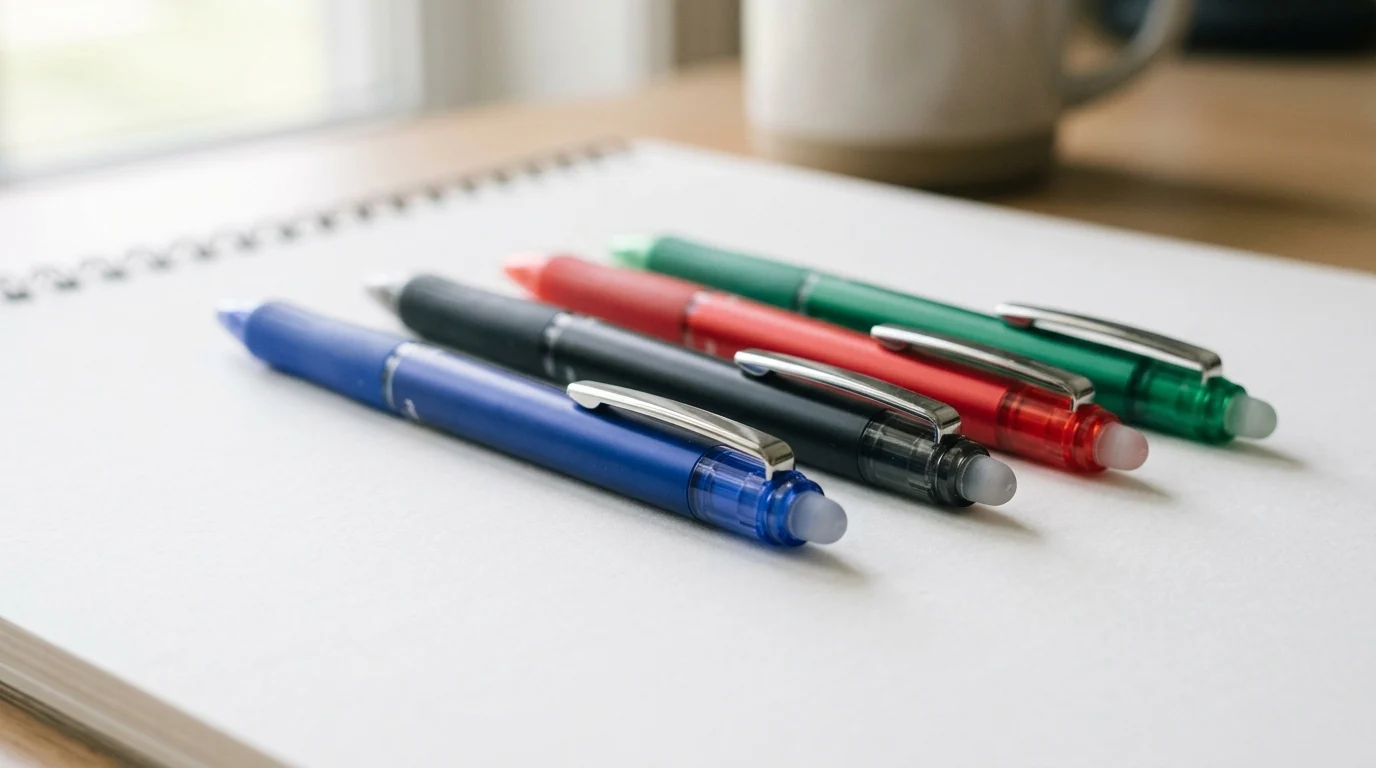
The erasing mechanism is driven by sophisticated thermo-sensitive ink technology, often referred to as metamochromatism. The ink contains microscopic capsules holding three key chemical components: a color pigment, a color developer, and a temperature regulator. When the user rubs the specialized hard rubber eraser at the end of the pen against the paper, the resulting kinetic friction generates localized heat. Once the surface temperature reaches a critical thermal threshold of approximately 60°C to 65°C (140°F to 149°F), the temperature regulator activates. This separates the color pigment from the developer, a chemical reaction that renders the ink completely translucent. The writing effectively disappears without removing any actual paper fibers.
Tip size, ink behavior, and paper interaction
The interaction between the 0.7 mm tip, the thermo-sensitive ink, and the paper substrate dictates the overall quality of the writing and erasing experience. The gel-based suspension ensures a smooth, uninterrupted flow, but it requires a careful balance of viscosity—typically maintained between 40 and 60 millipascal-seconds (mPa·s) at standard room temperature. Because the 0.7 mm tip deposits a thicker, more robust layer of this specialized ink, the thermal reaction generated by the eraser must penetrate deeper into the paper fibers to achieve total invisibility. Notably, this chemical change is entirely reversible. If the erased document is exposed to extreme cold, specifically dropping below -10°C (14°F) in a freezer or harsh winter environment, the color developer reconnects with the pigment, causing the erased ink to reappear on the page.
How to compare erasable gel pens with correction tape
For decades, liquid correction fluid and correction tape were the undisputed standard solutions for amending ink-based errors. However, the commercialization and refinement of reliable erasable gel pens have introduced a highly competitive, integrated alternative. Evaluating these two distinct correction methods requires a thorough analysis of workflow efficiency, consumable waste generation, and overall document presentation.
Key differences at a glance
When comparing these two methodologies, operational metrics reveal stark contrasts in daily utility and long-term consumable costs. The table below outlines the primary technical and practical differences between a standard 0.7 mm erasable pen and a conventional correction tape dispenser.
| Feature/Metric | Erasable Gel Pens (e.g., TWOHANDS 0.7mm) | Standard Correction Tape |
|---|---|---|
| Correction Mechanism | Thermal manipulation (friction heat) | Physical masking (titanium dioxide film) |
| Added Page Thickness | 0 microns (chemical change only) | 50-80 microns per application |
| Drying Time / Wait | 0 seconds (instant rewrite) | 0 seconds (requires careful pressure) |
| Consumable Waste | None (eraser is non-depleting) | High (plastic spools and carrier ribbons) |
| Archival Permanence | Low (susceptible to heat fading) | High (permanent physical barrier) |
This comparison clearly highlights how erasable ink streamlines the correction process by eliminating the need for secondary masking agents that alter the physical texture of the document.
How to choose the better option
Selecting the appropriate tool depends entirely on the permanence requirements of the document lifecycle. For temporary drafting and frequent revisions, erasable gel pens offer unmatched convenience and waste reduction. Conversely, standard correction tape remains the necessary choice for permanent, archival records that must withstand heat exposure without the risk of fading.
Key Takeaways
- The most important conclusions and rationale for erasable gel pens
- Specs, compliance, and risk checks worth validating before you commit
- Practical next steps and caveats readers can apply immediately
Frequently Asked Questions
How do erasable gel pens erase cleanly?
They use thermo-sensitive gel ink. Friction from the pen’s rubber tip creates heat, making the ink turn transparent instead of scraping it off the paper.
Why is a 0.7 mm erasable gel pen a good choice?
A 0.7 mm tip writes bolder, smoother lines and spreads pressure better on 70–80 gsm paper, helping reduce indentation and supporting cleaner erasing.
Can erased ink come back in cold weather?
Yes. If the paper gets very cold, around -10°C or below, the ink can reappear. Store notes at normal room temperature for best results.
Are erasable gel pens better than correction tape for schoolwork?
For frequent fixes, yes. They let students rewrite quickly without extra supplies, mess, or paper damage, which suits everyday classroom practice.
Where are TWOHANDS erasable gel pens most useful?
They’re practical for classrooms, planners, and fast-changing schedules where neat, temporary writing is needed and frequent corrections are expected.
WENDY
Post time: May-27-2026
