
In the promotional merchandise industry, the marker may seem like a humble tool—but its ink chemistry, tip geometry, and line quality can make or break a brand’s on-product presentation. For distributors outfitting corporate gifting programs, trade show kits, or retail-ready packaging lines, the choice between pens with dual-line (double-outline) capability and conventional single-line markers is a procurement decision with real cost and quality implications.
This guide unpacks the technical, operational, and regulatory dimensions that procurement managers need to evaluate before placing orders.
1. Introduction: The Role of Outline Markers in Promotional Merchandise
The global promotional products industry exceeded $25 billion in revenue in 2024, with markers and writing instruments consistently ranking among the top 10 most distributed categories. Within this category, outline markers—markers capable of laying down a double parallel line in a single stroke—occupy a growing niche driven by three market forces:
- Customization demand: Corporate buyers want branded items that stand out. Outline markers enable decorative lettering, monogram effects, and border designs that single-line markers cannot replicate in one pass.
- Retail shelf competition: In competitive retail environments, products finished with decorative marker work (hand-crafted signage, artisanal packaging) command perceived premium pricing.
- Craft and hobby expansion: The global maker movement has driven distribution channels to stock markers suitable for adult coloring, architectural model work, and scrapbooking—all use cases where outline quality is a deciding factor.
Understanding the distinction between double-line and single-line markers is not an academic exercise. It is a procurement competency that directly affects supplier relationships, reorder logic, and end-client satisfaction.
2. Technical Principles: How Double-Line and Single-Line Markers Work
2.1 Single-Line Marker Mechanics
A standard single-line marker delivers ink through one tip aperture. The ink flow is governed by three variables:
- Capillary pressure within the felt or fiber reservoir
- Tip contact angle against the writing surface
- Pressing force applied by the user’s hand
These variables combine to produce a single, consistent stroke width determined by the tip’s cut shape—round, chisel, brush, or needle point. The line is uniform in width and opacity along its length, assuming consistent hand pressure.
2.2 Double-Line (Outline) Marker Mechanics
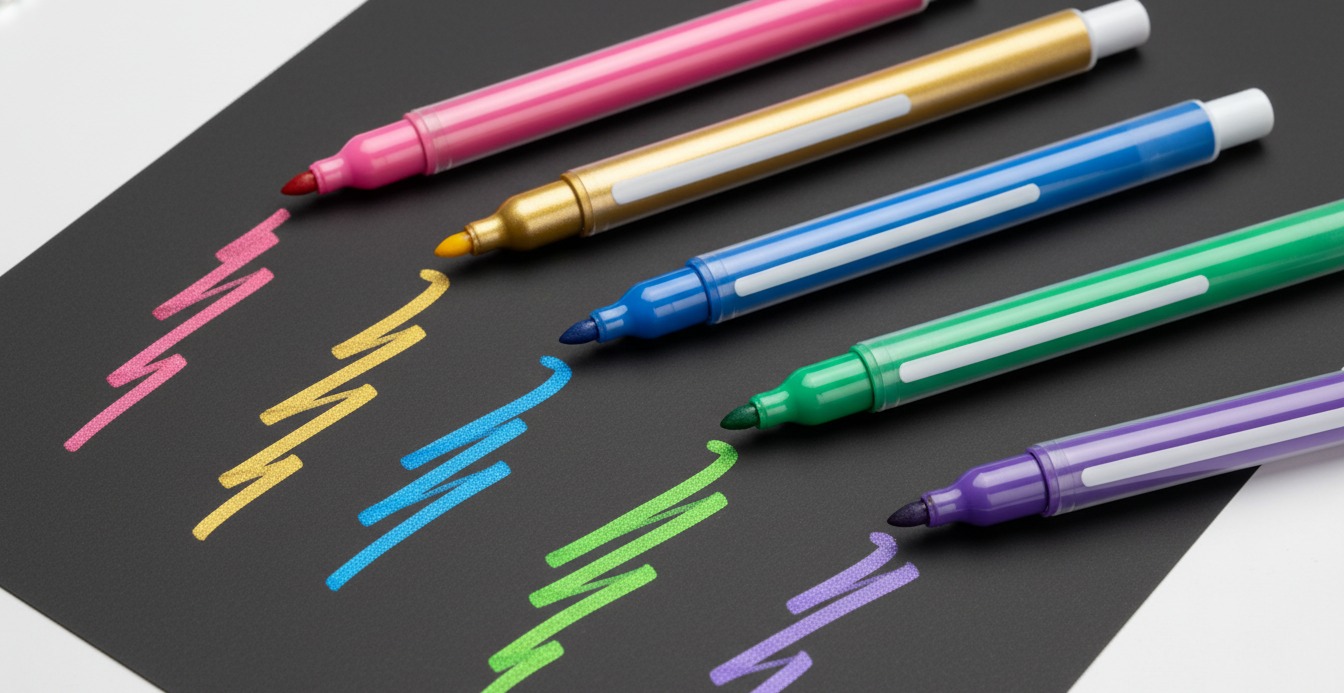
A double-line marker incorporates a dual-feed tip system: two ink channels converge at a specially engineered tip that holds two parallel felt or fiber prongs separated by a micro-gap. In a single stroke, the device deposits two parallel lines with a controlled gap between them.
The critical engineering parameters are:
- Prong spacing: Typically 0.8–2.5 mm, depending on the marker’s tip width designation
- Prong symmetry: Both lines must be deposited simultaneously to avoid “walking” (one line drifting relative to the other)
- Independent flow control: Each channel must regulate ink independently to prevent bleed between lines
- Self-centering geometry: Many double-line marker tips are bevel-cut or include a centering guide to help the user maintain straight-line quality
2.3 Visual Effects: A Side-by-Side Comparison
| Feature | Single-Line Marker | Double-Line (Outline) Marker |
|---|---|---|
| Line count per stroke | 1 | 2 (parallel, fixed gap) |
| Border / frame capability | Requires two strokes minimum | Single stroke, clean parallel edges |
| Outline / lettering effect | Outline method (two strokes, offset) | Direct single-stroke outline with fill potential |
| Hand-pressure sensitivity | Moderate | Higher—both lines must track evenly |
| Speed of decorative work | Slower (multiple passes) | Faster for parallel-line designs |
| Consistency at high volume | Moderate | Requires more operator skill or jig fixtures |
The visual distinction is immediately recognizable: outline markers produce ready-made borders and decorative frames, while single-line markers require operator skill and multiple passes to approximate the same effect.
3. Ink Formulations: Pigment vs. Dye — Color Saturation and Durability
The ink inside a marker is not a commodity. For promotional merchandise applications, ink choice determines color vibrancy, surface adhesion, durability under handling, and regulatory compliance.
3.1 Dye-Based Inks
Dye inks are dissolved colorants suspended in a solvent carrier (typically water or alcohol). Key characteristics:
- Color range: Virtually unlimited color mixing possible
- Saturation: High color brightness; ideal for vivid, eye-catching promotional work
- Surface adhesion: Moderate—tends to sit on surfaces rather than bond; can smudge on glossy materials
- Water resistance: Low to none without a fixative overcoat
- UV resistance: Poor to moderate—fades under prolonged sunlight exposure
- Typical applications: Paper, cardboard, matte plastics, craft surfaces
3.2 Pigment-Based Inks
Pigment inks use suspended solid particles (typically 0.1–5 μm diameter) that bond mechanically to surface textures. Key characteristics:
- Color range: Slightly more limited; some colors (fluorescent, neon) are difficult to formulate with pigments
- Saturation: Slightly lower brightness but superior opacity and coverage
- Surface adhesion: Superior—mechanical bonding to porous and semi-porous surfaces
- Water resistance: High
- UV resistance: High—pigments refract UV rather than absorb it
- Typical applications: Metal, glass, ceramic, glossy plastics, outdoor signage
3.3 Hybrid and Specialty Inks
Some manufacturers have developed hybrid inks combining dye and pigment characteristics:
- Alcohol-based pigment: Delivers brightness close to dye with durability approaching pigment
- Acrylic-fortified inks: Include acrylic micro-binders that improve adhesion on slick surfaces; common in acrylic marker formulations
- Solvent-based inks: Aggressive solvent carriers that etch micro-texture into surfaces for superior bonding; require ventilation and carry regulatory restrictions
For promotional merchandise distributors, ink formulation drives both the marker’s retail price and its end-use suitability. A marker that fades after three months on a drinkware item will generate returns and reputational damage.
4. Tip Specifications: 0.5 mm to 2 mm — Matching Tip Size to Application
Marker tip sizes are denominated in millimeters and refer to the maximum width of the stroke or, in the case of outline markers, the width of each individual prong.
4.1 Micro Tips (0.3–0.5 mm)
Also known as needle-point or ultra-fine tips, these deliver extreme line precision. Applications:
- Architectural model annotation
- Serial number or batch code marking
- Fine art illustration on paper and canvas
- Jewelry product marking
Limitation: Micro tips have very low ink flow rates and clog easily with pigment-based formulations. They are also unsuitable for outline work—too fragile to support dual-prong engineering.
4.2 Fine Tips (0.5–1.0 mm)
The most common range for general-purpose markers, fine tips balance ink flow and control. For outline markers, this range produces:
- Clean parallel lines with 0.8–1.2 mm gap spacing
- Suitable for letter outlines 8–14 pt equivalent
- Acceptable on paper, cardstock, and matte surfaces
Common use cases: Scrapbooking borders, product labeling, calligraphy practice, retail signage with small text.
4.3 Medium Tips (1.0–2.0 mm)
Medium tips are the workhorses of promotional merchandise decoration. Key attributes:
- Sufficient ink volume for bold outlines and broad decorative strokes
- Capable of fill-between-lines techniques (one color filling the gap between two outline lines)
- Compatible with dual-prong outline tips at 1.5 mm and 2.0 mm designations
Common use cases: Bottle and jar labeling, wooden gift items, canvas tote bags, glass award engraving layouts.
4.4 Chisel and Broad Tips (2.0–5.0 mm+)
These tips are designed for high-coverage and bold visual impact. Note that outline marker technology is rarely available above 2.5 mm prong width because the mechanical challenge of maintaining parallel line quality at broader widths increases significantly.
4.5 Tip Shape and Its Effect on Line Quality
| Tip Shape | Line Geometry | Outline Compatibility | Best For |
|---|---|---|---|
| Round (bullet) | Uniform width circle cross-section | Acceptable at fine/medium sizes | General writing, standard outlines |
| Chisel (flat) | Rectangular cross-section; angle-dependent width | Good for broad outlines | Signage, bold lettering |
| Brush | Variable width with pressure; tapered point | Poor—flow balance between lines is inconsistent | Artistic strokes, calligraphy |
| Needle (pinpoint) | Extremely fine, consistent | Not suitable for outline engineering | Precision work |
5. Material Compatibility: Paper, Metal, Glass, Plastic
Promotional merchandise spans an enormous range of substrates. A marker that performs admirably on kraft paper will fail on powder-coated metal unless its ink system is formulated for that surface. This section maps marker types to substrate performance.
5.1 Paper and Cardboard
Best performers: Dye-based and pigment-based markers at fine to medium tips
Paper is the most forgiving substrate because its cellulose fibers mechanically absorb and bond with ink. All standard marker formulations work well. For cardboard with visible texture, pigment-based inks provide superior opacity.
Considerations: Bleed-through on lightweight paper; use low-bleed dye formulations for thin paper applications.
5.2 Metal (Bare, Painted, or Powder-Coated)
Best performers: Solvent-based pigment inks; alcohol-based pigment inks with acrylic binders
Bare metal requires ink with sufficient solvation to penetrate oxide layers. Painted and powder-coated metal requires adhesion promoters or mechanical keying through micro-abrasion in the ink formulation.
Note: Standard dye-based pens will bead and scratch off smooth metal surfaces within hours of application.
5.3 Glass and Ceramic
Best performers: Solvent-based inks with glass adhesion promoters; acrylic-fortified pigment inks
Glass presents a unique challenge: its extremely smooth, non-porous surface offers no mechanical keying for standard inks. Specialized formulations containing silane coupling agents or acrylic co-binders are required for durable adhesion.
Considerations: Even with proper formulations, glass marking often requires a primer wipe. Decorative work on glass drinkware (a popular promotional item) should be cured with UV light or heat to improve durability.
5.4 Plastic (PET, PVC, Polypropylene, Polystyrene)
Best performers: Alcohol-based pigment inks; acrylic-fortified inks
Plastic compatibility is highly dependent on the specific polymer’s surface energy. Low-surface-energy plastics (polypropylene, polyethylene) resist ink adhesion unless the ink contains specific wetting agents and adhesion promoters.
Testing protocol: Before committing to a volume order, conduct a 72-hour adhesion test on each plastic substrate type you intend to decorate.
5.5 Wood (Raw, Painted, or Lacquered)
Best performers: All dye and pigment formulations work on raw wood due to its porosity. Acrylic inks are preferred on painted or lacquered wood to avoid solvent damage to the finish.
6. Procurement Decision Framework: MOQ, Pricing, and Supplier Selection
For promotional merchandise distributors, procurement is a balancing act between unit cost, minimum order quantities, lead times, and product consistency.
6.1 Minimum Order Quantities (MOQ)
Marker MOQs vary significantly by manufacturer tier:
- OEM/factory direct: MOQ typically 3,000–10,000 units per color/tip configuration; longest lead time (4–12 weeks) but lowest unit cost
- Wholesale distributors: MOQ typically 500–3,000 units; lead time 2–4 weeks; moderate unit cost
- Retail fulfillment suppliers: MOQ as low as 12–50 units per SKU; same-day or 1-week fulfillment; highest unit cost but lowest inventory risk
For a distributor launching a new corporate gifting program, the recommendation is to start with a retail or wholesale supplier to validate product-market fit before committing to OEM volumes.
6.2 Price Bands by Marker Type
| Marker Type | Retail Unit Price (USD) | Wholesale Unit Price (USD) | OEM Unit Price (USD) |
|---|---|---|---|
| Standard single-line, fine tip (dye) | $1.50–$3.00 | $0.60–$1.20 | $0.15–$0.35 |
| Standard single-line, medium tip (pigment) | $2.00–$4.00 | $0.80–$1.60 | $0.20–$0.50 |
| Double-line outline marker (fine/medium) | $3.50–$7.00 | $1.50–$3.00 | $0.40–$1.00 |
| Specialty solvent-free pigment (glass/metal) | $4.00–$9.00 | $1.80–$4.00 | $0.60–$1.50 |
These ranges reflect 2024 market data and fluctuate with raw material costs, particularly for pigments (titanium dioxide, organic colorants) and alcohol solvents.
6.3 Supplier Selection Criteria
Use a weighted scoring model for supplier evaluation:
- Product consistency (weight: 30%): Order samples across 3 lots. Measure line width with digital calipers. Calculate coefficient of variation; reject suppliers with CV > 8%.
- Certification portfolio (weight: 25%): Must hold applicable safety certifications for target markets (see Section 7).
- Customization capability (weight: 20%): Can they produce custom ink colors to PMS/Pantone specs? What is their color matching tolerance (typically ΔE < 3.0)?
- Lead time reliability (weight: 15%): Request on-time delivery records from 3 prior clients.
- Price competitiveness (weight: 10%): Price should be evaluated last, after confirming quality and compliance.
6.4 Total Cost of Ownership (TCO) Consideration
The unit price is only part of the procurement equation. TCO for marker procurement includes:
- Replacement rate: High-quality markers last 3–5× longer on surface than budget alternatives
- Returns and complaints: A single product recall or client return batch costs far more than the price premium on quality markers
- Storage shelf life: Water-based dye markers have a shelf life of 18–24 months; alcohol-based markers 24–36 months. Factor expiration into inventory management
7. Certification Requirements: EN71, ASTM D4236, and ACMI
Promotional merchandise frequently crosses international borders and enters end-use contexts where consumer safety is regulated. Three certifications are particularly relevant for marker procurement.
7.1 EN71 (European Standard)
EN71 is the European toy safety standard series administered by CEN. While markers are not always classified as toys, products intended for or likely to be used by children under 14 must comply.
EN71-3 (migration of certain elements) is the most relevant for markers, establishing limits for heavy metals in ink:
- Antimony: < 60 mg/kg
- Arsenic: < 25 mg/kg
- Barium: < 25,000 mg/kg
- Cadmium: < 75 mg/kg
- Chromium: < 60 mg/kg
- Lead: < 90 mg/kg
- Mercury: < 60 mg/kg
- Selenium: < 500 mg/kg
For EU market distribution, insist on current EN71 test reports from an accredited third-party laboratory (not just a manufacturer declaration of conformity).
7.2 ASTM D4236 (United States)
ASTM D4236 is the US standard for chronic hazard labeling of art materials, administered by the Art and Creative Materials Institute (ACMI). Markers that pass ASTM D4236 testing carry the ACMI AP (Approved Product) seal.
The standard addresses:
- Chronic health hazards (carcinogens, mutagens, reproductive toxicants)
- Acute toxicity thresholds
- Required hazard labeling
Without ASTM D4236 / ACMI certification, a distributor cannot legally sell markers as art materials in US retail channels.
7.3 ASTM D4303 (Standard Test Methods for Light Stability of pigments)
While not a certification requirement per se, ASTM D4303 establishes standardized test methods for evaluating the lightfastness (resistance to fading under UV exposure) of artist-grade pigments. For outdoor or display-use promotional items, specifying pigments that pass ASTM D4303 ensures color retention over time.
7.4 REACH Compliance (EU)
For EU market entry, all chemical substances in the marker ink must be registered under REACH (Regulation EC 1907/2006). Distributors importing markers for resale in the EU have an obligation to verify supplier REACH compliance for substances of very high concern (SVHCs).
8. Domestic vs. Imported Brands: Key Differentiating Metrics
The marker market spans a wide quality spectrum from budget Asian-manufactured markers to precision-engineered Japanese and German brands. Key comparison dimensions:
8.1 Ink Flow Consistency
Premium brands invest in precision felt-fiber cutting and controlled ink viscosity (typically 15–80 cP depending on formulation). Budget markers often show ink flow variation within the first 10% of the felt’s ink load, producing inconsistent line width as the marker is used.
8.2 Tip Durability
High-quality marker tips are manufactured from selected felt or fiber with consistent density and bonded with archival-quality adhesives. Tip detachment (felt slipping off the nib holder) is a failure mode almost exclusively seen in budget products.
8.3 Color Matching Accuracy
Professional-grade markers meet ΔE < 2.0 color tolerance against target PMS or Pantone references. Consumer-grade markers may have ΔE tolerances of 5–10, which is unacceptable for brand-consistent promotional work.
8.4 Ink Formulation Stability
Quality manufacturers maintain batch-level formulation records and conduct QC against ASTM D4303 lightfastness standards. Smaller manufacturers may not conduct batch-level testing, leading to color drift between production lots.
8.5 Regulatory Documentation
Reputable manufacturers provide:
- Current Safety Data Sheets (SDS/MSDS) for each ink formulation
- Third-party test reports (EN71, ASTM D4236)
- REACH SVHC disclosure statements
- California Prop 65 compliance documentation for US sales
Domestic manufacturers (Japan, Germany, South Korea) typically provide documentation as standard practice. Some Asian import brands provide documentation only on request or at additional cost.
8.6 Price vs. Value Summary
| Metric | Premium (Japan/Germany/Korea) | Mid-tier (Taiwan/Malaysia) | Budget (China mass market) |
|---|---|---|---|
| Line consistency CV | < 5% | 5–10% | > 10% |
| Color matching ΔE | < 2.0 | 2.0–5.0 | 5.0–10.0 |
| EN71 documentation | Standard | Available | Often unavailable or extra cost |
| Custom color MOQ | 500–1,000 units | 1,000–3,000 units | 5,000+ units |
| Typical unit cost (OEM) | $0.50–$1.20 | $0.25–$0.60 | $0.10–$0.30 |
9. Conclusion: Procurement Recommendations for Distributors
Choosing between double-line outline markers and single-line markers is not simply a product selection—it is a strategic decision about the scope of decorative capability you can offer your clients.
9.1 When to Choose Double-Line (Outline) Markers
- Your clients’ products require decorative borders, frame designs, or monogram effects as standard spec
- Speed of decoration is a bottleneck in your clients’ fulfillment process
- You are targeting the craft, maker, and adult coloring market segments
- You can train operators on outline marker technique or provide jig fixtures to maintain line quality
9.2 When to Choose Single-Line Markers
- Budget constraints dominate the procurement decision
- End-use applications require fine-point precision (model work, serial numbers)
- The product range includes highly specialized substrates that require specialty ink formulations better available in single-line formats
- Volume requirements are small and MOQ compatibility with outline markers is unfavorable
9.3 General Procurement Checklist
- Sample first: Always order 3–5 sample units and test on target substrates before volume orders
- Match ink to substrate: Verify ink formulation compatibility for each material type in your product catalog
- Require certifications: Insist on EN71, ACMI/ASTM D4236, or equivalent certifications for all applicable markets
- Calculate TCO: Factor in replacement rates, returns, and shelf life—not just unit price
- Verify documentation: SDS, test reports, and compliance documentation should be included as standard, not as a paid extra
- Plan for customization: If you anticipate custom color orders, verify the supplier’s color-matching capability and MOQ before establishing the relationship
The right marker, in the right formulation, with the right tip specification, sourced from a supplier with demonstrated quality and compliance discipline—these are the variables that determine whether your promotional merchandise program runs smoothly or becomes a source of costly rework and client attrition.
Frequently Asked Questions (FAQ)
Q1: Can double-line outline markers be used on all same surfaces as single-line markers?
Technically yes, but with caveats. The dual-prong tip on outline markers requires consistent ink flow to both prongs simultaneously. On highly absorbent surfaces, one prong may dry out faster than the other, causing line quality degradation. Always test outline markers on your specific substrates before volume deployment.
Q2: What is the typical gap width between the two lines on an outline marker?
Most commercial outline markers have a gap width of 1.0–2.5 mm, depending on the tip width designation. Fine-tip outline markers (0.5 mm prongs) typically have a 0.8–1.2 mm gap. Medium-tip outline markers (1.0–2.0 mm prongs) may have gaps up to 2.5 mm. The gap is fixed by the tip manufacturing geometry and cannot be adjusted by the user.
Q3: Are outline markers significantly more expensive than single-line markers?
Yes, outline markers typically command a 20–40% unit price premium over equivalent-quality single-line markers due to the more complex tip engineering and dual ink channel system. However, when used for border and frame work, the labor time savings per item often offset the unit cost premium, particularly in high-volume decoration workflows.
Q4: Which certifications are mandatory for selling markers in the EU and US?
In the EU, EN71 compliance (specifically EN71-3 for heavy metal migration) is effectively mandatory for any marker sold into retail channels, particularly for products that could be used by children. In the US, ASTM D4236 certification and the associated ACMI AP seal are required for art material labeling. Without these, legal sale in major retail channels is not possible.
Q5: What is the shelf life of markers, and how does storage affect performance?
Water-based dye markers typically have a shelf life of 18–24 months from manufacture date. Alcohol-based and solvent-based markers last 24–36 months. Storage temperature and humidity affect shelf life: excessive heat accelerates ink degradation and evaporation of solvent carriers. Store markers horizontally or tip-down (depending on manufacturer recommendation) in a climate-controlled environment between 15°C and 25°C.
Q6: How do I match marker colors to a specific brand PMS/Pantone color?
Professional color matching requires a spectrophotometer measurement against the target standard and formulation refinement by the ink supplier’s lab. For promotional merchandise distributors, verify that your supplier can achieve ΔE < 3.0 tolerance against your target PMS reference. Request signed color approval samples (physical drawdowns on target substrates) before committing to OEM production runs.
Post time: Jun-04-2026
