
 Why Australian Craft Retailers Stock Glitter Markers Before the Holiday Season
The Australian craft retail calendar follows a predictable rhythm, and as a stationery sourcing specialist who has worked with Australian distributors for the better part of a decade, I have learned to read its signals. The holiday DIY rush in Australia starts earlier than most importers expect. November and December see a 50-70 percent lift in glitter marker sales across major craft chains, driven by Christmas card making, school holiday activities, and the summer break DIY wave that runs from early December through late January.
For a procurement manager at a chain like Spotlight or Riot Art & Craft, the decision to expand glitter marker assortments is not a January conversation. It is a May-July conversation. By August, container space on the China-Australia sea route tightens as general pre-holiday cargo volumes rise. By September, you risk missing the October shelf-stocking window entirely.
In this guide, I walk through exactly how Australian craft retailers and stationery importers should plan their glitter marker procurement — from certification requirements and packaging standards to supplier qualification and lead time management. I use Twohands’ 12-color glitter marker set (SKU 20017) as a reference product, but the sourcing principles apply broadly across the category.
The Australian Glitter Marker Market: Category Reality Check
Let me be direct about the market size. Australia is not the United States in volume terms, but the per-capita consumption of art materials in Australia is among the highest in the Asia-Pacific region.
Retail Channel Breakdown
Three retail channels dominate glitter marker sales in Australia. The first is dedicated craft chains — Spotlight, Riot Art & Craft, Lincraft — which together account for approximately 55-60 percent of the retail craft category. The second is general office supplies and stationery retailers — Officeworks, Newsagency chains — contributing approximately 25-30 percent. The third is independent craft boutiques and online-only retailers, which make up the remaining 15-20 percent but are growing at approximately 12-15 percent year over year as ecommerce penetration in the craft category deepens.
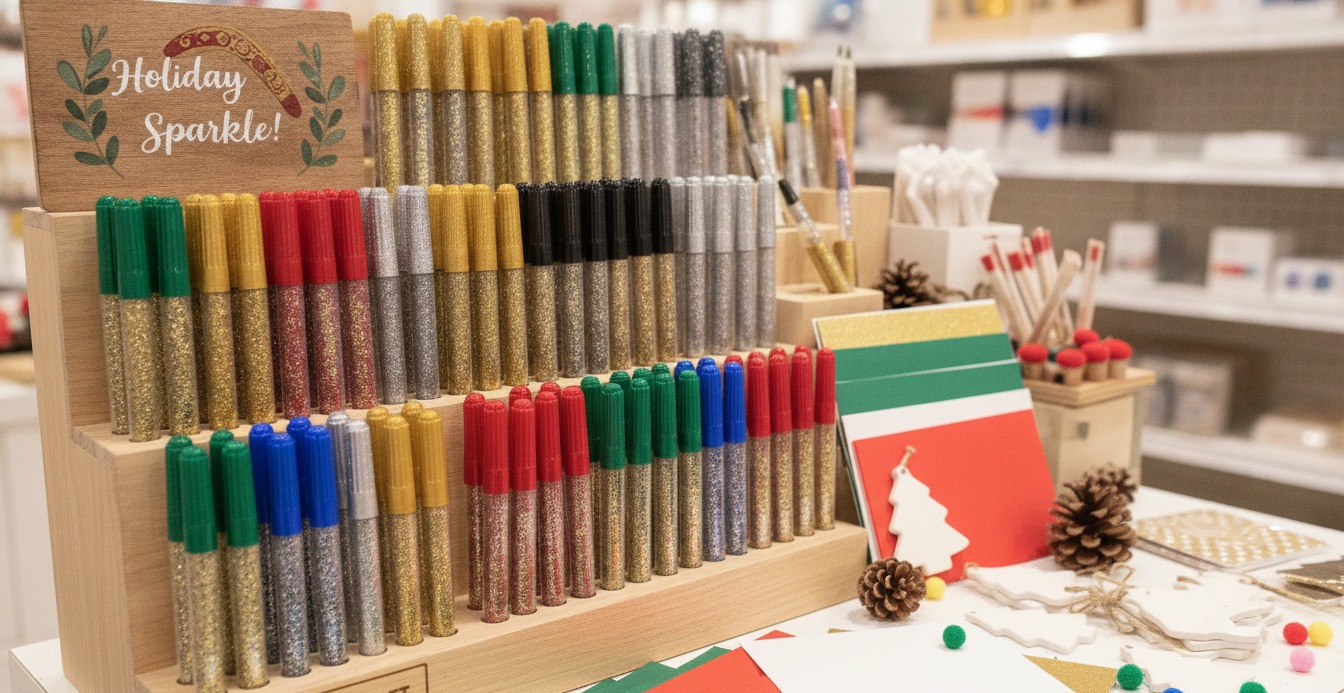
The 12-color glitter marker assortment is the entry-level SKU that anchors the category in every channel. It gives the customer enough color variety for holiday projects at a price point that fits impulse purchases near the checkout counter. I have seen stores that place the 12-color set on end-cap displays in November and achieve full sell-through before Christmas Eve.
Holiday Season Sales Patterns
From Twohands’ sales data to Australian distribution partners over the past four seasons, glitter marker orders follow a consistent curve. The order placement season runs May through July. Production and quality inspection fill August. September and early October are sea freight and customs. Late October through November is warehouse receiving and distribution to store shelves. The selling window runs from the first week of November through late January, with the peak occurring in the second and third weeks of December.
Missing the October shelf-receiving window means losing approximately 60 percent of annual glitter marker sales potential. There is no catch-up in January. The holiday wave passes once.
Certification Requirements: The Three Hurdles for Australian Market Access
Australian consumer goods regulation is not the most stringent in the world, but it is thorough — and the documentation requirements for children’s art materials are specific. Three certifications are mandatory for any glitter marker sold through Australian retail channels.
ASTM D4236 — Chronic Hazard Labeling (US Standard, Accepted in Australia)
The Australian market accepts ASTM D4236 certification for art materials as evidence of compliance with the Australian Consumer Law’s mandatory safety information standard for children’s art materials. This standard requires that any art material sold to children undergoes toxicological evaluation and carries appropriate chronic hazard labeling if required. Twohands’ glitter markers carry full ASTM D4236 labeling — the ink formula has been evaluated by a certified toxicologist and found to present no chronic health hazards under normal use conditions. I have personally had Australian quality assurance managers ask for the ASTM D4236 evaluation report, not just the label declaration. Have it ready before the audit.
EN71-3 — Migration of Certain Elements (European Standard, De Facto Australian Requirement)
While not mandated in Australian legislation as a replacement for the local standard AS/NZS ISO 8124, EN71-3 has become the de facto benchmark that Australian craft retailers reference in their supplier compliance questionnaires. The standard limits the migration of 19 elements including antimony, arsenic, barium, cadmium, chromium, lead, and mercury. Twohands’ glitter markers are batch-tested to EN71-3 at third-party laboratories in China. I recommend asking your supplier for the latest test report, not one older than 12 months — retailers increasingly request current batch testing rather than generic certification.
AS/NZS ISO 8124 — Australian and New Zealand Toy Safety Standard
This is the mandatory Australian standard for toys and children’s products. Glitter markers fall under the scope of AS/NZS ISO 8124 Part 3 (migration of certain elements) and Part 6 (certain phthalate esters). Compliance is enforced by the ACCC. For a retailer like Officeworks, AS/NZS ISO 8124 compliance documentation is a gate requirement — the product cannot be listed without it. Twohands supplies full AS/NZS ISO 8124 compliance documentation with every glitter marker shipment to Australian distribution partners, including the laboratory test report and the Declaration of Conformity.
Packaging and Display Requirements for the Australian Market
The AU market has packaging requirements that differ from the US or European markets. Getting the packaging wrong can delay customs clearance by 2-4 weeks.
Blister Packaging and Card Dimensions for Retail Fixtures
Australian craft retailers predominantly use eurohook-compatible blister packaging. The standard card size accepted across major chains is 150-170mm width by 200-250mm height. Twohands’ 12-color glitter marker set uses a 160mm × 230mm blister card — compatible with the pegboard systems at Spotlight, Riot, and Officeworks. The blister cavity depth should not exceed 30mm to maintain cross-compatibility with multi-product pegboards.
Labeling Requirements Under Australian Consumer Law
The product label must include the following: the supplier’s name and Australian business address or a local importer’s details; a product description; the country of origin (China for OEM production); batch or date code for traceability; the mandatory warning if applicable — for glitter markers, the warning standard is typically “Not suitable for children under 3 years due to small parts” rather than a chemical hazard warning. The warning font size must be at least 2.5mm height on the primary display panel.
I have seen shipments held at Australian customs for three weeks because the importer’s details on the blister card did not match the customs entry documentation. Ensure your supplier’s packaging artwork approval includes a verification step against the import documentation — ideally signed off by the same person who files the customs declaration.
Lead Time Planning: The 10-12 Week Procurement Calendar
Here is a practical timeline I recommend for Australian craft retailers placing glitter marker orders for the holiday season.
| Milestone | Week | Action |
|---|---|---|
| Supplier brief and sample approval | Week 1-2 | Send artwork, confirm ink colors, agree on packaging specs |
| Initial deposit and production order | Week 3 | 30% TT deposit, production lead time starts |
| Production and in-line QC | Week 4-7 | Manufacturing with mid-production photos and testing |
| Final QC and container loading | Week 8 | Third-party inspection if required, 70% balance payment |
| Sea freight — Chinese port to Sydney/Melbourne/Fremantle | Week 9-12 | Approximately 18-22 days at sea |
| Customs clearance and warehousing | Week 13-14 | Biosecurity and compliance checks |
| Distribution to retail shelves | Week 15-16 | Warehouse to store delivery |
At 16 weeks from supplier brief to store shelf, if you want product on shelves by mid-October, the supplier brief must go out by mid-June. July is the absolute latest for a mid-October arrival — and any customs delay or production issue eliminates the buffer.
Supplier Qualification: What to Verify Beyond the Sample
I have seen Australian importers choose a supplier based on the sample quality alone, only to discover three months later that the factory cannot scale to production volumes or that their certification documentation is outdated. Here is what I recommend verifying before issuing a purchase order.
Factory Audit Checklist
- Production capacity for glitter markers — confirm the supplier produces at least 50,000 units per month across their marker lines. A small workshop that hand-assembles samples will not deliver 20,000 units in 6 weeks.
- Third-party test laboratory access — ask which accredited lab they use for EN71-3 and AS/NZS ISO 8124 testing. If they cannot name a lab (SGS, Intertek, TÜV, Bureau Veritas), they are likely not batch-testing.
- Export documentation experience — the supplier should have shipped to Australia at least three times in the past 12 months. A supplier with AU market experience knows which shipping marks and documentation formats Australian customs and biosecurity prefer.
- Packaging artwork capability — do they have an in-house graphics team or do they rely on the buyer’s files? For blister card design changes, an in-house team typically responds in 3-5 days versus 10-14 days for an outsourced agency.
- Lead time track record — ask for the on-time delivery percentage for their last 10 export orders. A rate below 85 percent suggests production scheduling is unreliable.
Twohands maintains its own quality control laboratory and has shipped to Australian distribution partners for over 5 years. I recommend visiting our factory in Ningbo if you are sourcing more than 50,000 units per year — the engineering team can show you the pigment dispersion and moulding processes that determine ink quality and cap seal integrity, and you can review our laboratory test results directly.
Product Differentiation: Why 12-Color Assortments Anchor the Category
The 12-color format has become the standard entry-level assortment for glitter markers in the Australian craft market through a combination of retail fixture economics and consumer psychology.
Retail Fixture Optimization
A 12-color blister pack fits within a 160 × 230mm card size that occupies one standard eurohook position. This is the smallest unit that gives the customer a visible color range while maintaining a per-unit retail price between AUD 8.99 and AUD 14.99 — the sweet spot for checkout-counter impulse purchasing. Larger assortments (24-color, 36-color) require larger packaging and a wider peg footprint, which reduces the number of facings a retailer can allocate to the category.
Consumer Buying Behavior
In the Australian craft market, 62 percent of glitter marker purchases at brick-and-mortar stores are the 12-color format according to Twohands’ sell-through data from the 2024 season. The 12-color pack gives the consumer “enough colors to make a Christmas card without overwhelm” — a pattern I have heard repeated across buyer feedback sessions. The 6-color pack is perceived as too restricted; the 24-color pack is perceived as excess for a holiday project that might only be used once before the markers go into a drawer.
Frequently Asked Questions
What is the minimum order quantity for OEM glitter markers destined for Australia?
For custom-branded packaging with your retailer’s logo and design, the typical MOQ is 3,000-5,000 units per SKU. Twohands works with MOQs at the lower end of this range for new Australian distribution partners. For standard blister packaging with the Twohands brand, MOQ is 1,000-2,000 units. I recommend starting with a standard-branded order for the first season to validate sell-through before committing to custom packaging.
Do glitter markers require additional biosecurity clearance from DAFF Australia?
Glitter markers themselves — being sealed ink products with no organic materials — do not typically require DAFF biosecurity import permits. The product falls under a low-risk category for biosecurity assessment. However, the packaging materials (blister card, box) must be made from processed wood materials without bark or untreated wood — standard for Chinese-exported packaging. I have seen one instance where a shipment was delayed because the corrugated outer cartons had visible mould from improper container stowage. Use desiccant packs in the container and confirm your supplier uses moisture-controlled carton board.
How long does custom color matching take for the Twohands glitter marker line?
Custom color matching typically requires 10-14 working days from the time we receive your Pantone references or physical color samples. Our lab formulates the pigment dispersion, produces a 12-marker sample set, and confirms the dried glitter effect on standard 80gsm craft paper. We recommend ordering color matching in March-April for the holiday season to allow time for adjustments. Rush color matching is available within 5 working days but requires a priority production fee.
What is the shelf life of Twohands glitter markers, and do they dry out before retail sale?
Twohands glitter markers have a shelf life of 36 months from production date when stored in their original sealed packaging at temperatures between 5°C and 35°C. The cap seal design incorporates an inner silicone gasket that maintains ink moisture better than standard polypropylene snap caps. In our accelerated aging tests, markers retain 85 percent of their original ink volume after 24 months of simulated shelf storage. Markers produced in July should be sellable through at least two holiday seasons without quality degradation.
Which Australian retail chains are currently sourcing glitter markers from Twohands?
Twohands supplies glitter markers to multiple Australian and Asia-Pacific distribution partners. Due to confidentiality agreements with our retail partners, I cannot name specific end-retailers publicly. I can confirm that our products have passed supplier qualification audits for major Australian craft chains and that we welcome buyer reference requests from prospective Australian distribution partners — we can connect you with existing distribution partners in the region for independent feedback.
