
The choice between an Ultra Fine Tip and a chisel tip dry erase marker depends on your specific task. Your desired outcome also influences this decision. This guide helps you determine the best marker for your needs. For detailed work, TWOHANDS Ultra Fine Tip Dry Erase Markers provide exceptional precision.
Key Takeaways
- Ultra fine tip markers are best for small details and precise drawings. They help you write small notes clearly.
- Chisel tip markers are good for big writing and filling large spaces. They make words easy to see from far away.
- Having both types of markers is helpful. You can use the fine tip for details and the chisel tip for big ideas.
Understanding the Ultra Fine Tip Dry Erase Marker

What Defines an Ultra Fine Tip?
An Ultra Fine Tip dry erase marker features a very narrow, pointed nib. This design allows for exceptionally precise and delicate lines. It contrasts sharply with broader markers, offering a distinct advantage for detailed work.
Precision and Detail with Ultra Fine Tip Markers
These markers excel in tasks requiring high accuracy. They provide unmatched precision for fine lines, small annotations, and accurate technical drawings. This precision is crucial for translating complex ideas into clear plans. For instance, they create fine lines for detailed schematics, enabling controlled, clean lines for intricate components. Users make small annotations and revisions on architectural plans with ease. The markers produce clean, graphic lines and prevent skips or blobs. They ensure accuracy in technical drawings, adhering to industry standards for line accuracy. Every element communicates its intended information without ambiguity.
Advantages of Using an Ultra Fine Tip
The benefits of an Ultra Fine Tip marker are clear. They enhance clarity and readability. Quick-drying ink prevents smudges and ghosting, maintaining a clean appearance. This improves the overall clarity of drawings. They also produce crisp, clear lines for professional presentations. This conveys complex ideas effectively and reflects attention to detail. TWOHANDS Ultra Fine Tip markers offer durability and consistent performance. Optimized ink flow ensures a smooth writing experience without skipping or blotching. Durable tips resist fraying, ensuring consistent line width. Proper care, such as sideways storage and immediate cap replacement, extends marker life. This makes them effective for many sessions.
Limitations of the Ultra Fine Tip
Despite their precision, Ultra Fine Tip markers have limitations. Their fine lines might not offer sufficient coverage or visibility for larger applications. Viewing them from a distance can be challenging. This reduced visibility is a significant drawback in certain environments. It implies a limitation for ultra-fine tips in terms of coverage and readability from afar. They are not ideal for filling large areas or creating bold headings.
Ideal Applications for Ultra Fine Tip Markers
Ultra Fine Tip markers are indispensable in many professional settings. They are perfect for marking measurements and cuts in woodworking and construction. Professionals use them for writing on tools and equipment for identification. They also label and organize jobsite materials. These markers make notes in dusty or wet conditions effectively. Creative professionals, such as graphic designers, use them for tasks like creating roughs, technical drawings, and sketches. Artists also use them for adding finishing touches, details, and contours with absolute precision.
Exploring the Versatility of the Chisel Tip Dry Erase Marker
What Defines a Chisel Tip?
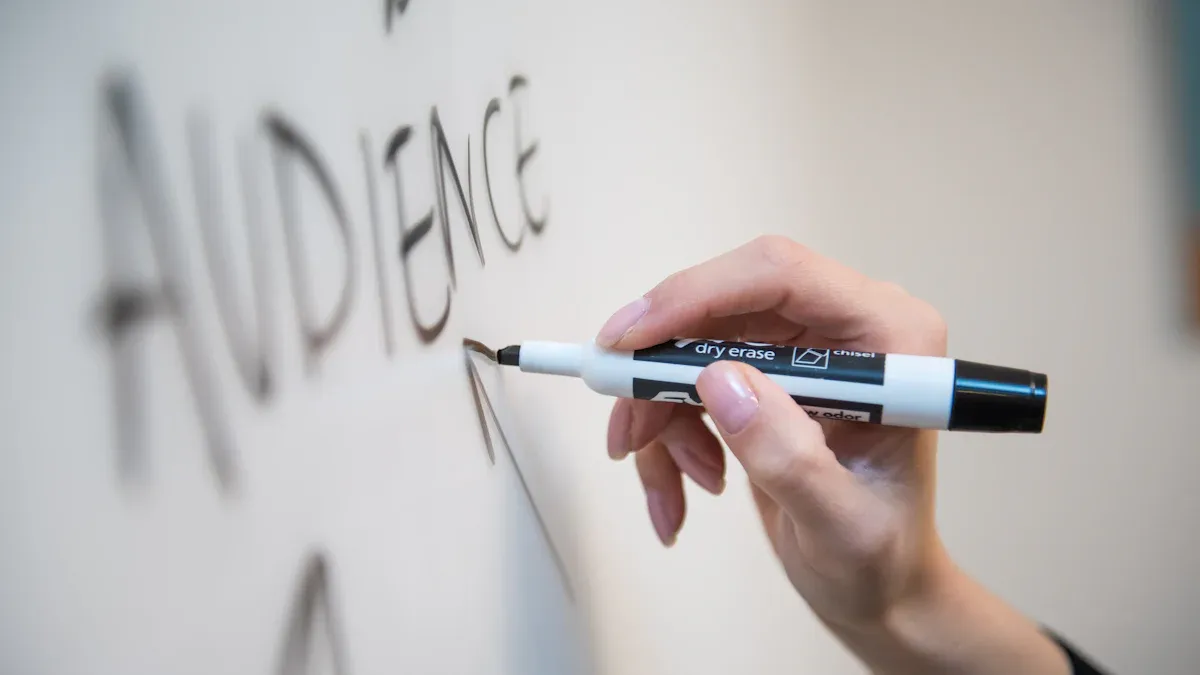
A chisel tip dry erase marker features a broad, angled nib. This unique design allows users to produce various line widths. It contrasts with the fine point of other markers, offering distinct versatility for different writing and drawing needs.
Key Characteristics: Adaptable Line Widths and Boldness
Chisel tips are versatile tools. They allow for adaptable line widths. Users utilize the wide, flat side of the tip to color large areas with ease. Conversely, using the chisel tip itself creates slightly thinner lines. This dual functionality makes chisel tip markers ideal for calligraphy and other art forms involving lettering. They offer both broad coverage and finer detail. Their broad, angled shape produces both thick and thin lines depending on the angle. This design provides control and versatility for filling large areas and creating bold strokes. The broad surface efficiently covers more ground. This makes them ideal for backgrounds or larger design elements.
Advantages of Using a Chisel Tip
Chisel tips offer both broad and fine lines. This provides versatility for writing and drawing. This tip style is favored for creating headings and performing detailed work. Chisel tips enable broader strokes and varying line widths. They suit different writing styles. They are excellent for presentations and brainstorming sessions, ensuring high visibility for all participants.
Limitations of the Chisel Tip
Chisel tip markers, while versatile, have limitations. They lack the extreme precision of ultra-fine tips for very small details. Their broader strokes can make small writing or intricate diagrams appear less crisp. They might not be suitable for extremely confined writing spaces.
Ideal Applications for Chisel Tip Markers
Chisel tip markers excel in environments requiring high visibility. They are perfect for large whiteboards in conference rooms. Teachers use them for classroom instruction. Presenters create bold headings and diagrams. Brainstorming sessions benefit from their ability to quickly fill large areas. Architectural drawings also utilize their straight lines and precision.
Direct Comparison: Ultra Fine Tip vs. Chisel Tip Performance
Visibility and Readability: Which Stands Out?
The choice between an Ultra Fine Tip and a chisel tip marker significantly impacts visibility and readability. Chisel tip markers create bold, thick lines. These lines are easily visible from a distance, making them ideal for large whiteboards in conference rooms or classrooms. They ensure everyone in the audience can clearly see the information presented. Conversely, Ultra Fine Tip markers produce thin, precise lines. These lines are perfect for detailed notes or diagrams viewed up close. While they offer superior clarity for intricate information, their fine lines can be difficult to read from across a room.
Efficiency in Writing and Drawing: Covering Space
Efficiency varies greatly between these two marker types when covering space. Chisel tip markers are highly efficient for tasks requiring broad coverage. Their wide nib allows users to quickly fill in large sections, create prominent titles, or draw thick lines with minimal effort. This makes them ideal for brainstorming sessions or presentations where speed and impact are important. Ultra Fine Tip markers, by contrast, are less efficient for covering large areas. Their fine point means users must make many strokes to fill a space. However, they are highly efficient for dense information, allowing users to fit more text or detail into a smaller area.
Versatility for Diverse Tasks
Chisel tip markers offer greater versatility for diverse tasks. Users can hold them at different angles to produce varying line widths, from broad strokes to relatively thinner lines. This adaptability makes them suitable for a range of uses, including writing, drawing, and highlighting. They can serve multiple purposes within a single presentation or project. Ultra Fine Tip markers are more specialized. Their primary strength lies in precision and detail work. While excellent for their specific niche, they offer less versatility for tasks requiring broad strokes or varied line widths.
Erasability and Ghosting Considerations
Both Ultra Fine Tip and chisel tip markers, when made with quality ink, should erase cleanly from non-porous surfaces. The primary factor affecting erasability and ghosting is the quality of the marker’s ink and the whiteboard surface itself, rather than the tip size. However, broader strokes from a chisel tip marker deposit more ink. If the ink quality is poor or the whiteboard surface is old and porous, the larger ink deposit might appear to ghost more noticeably than the lighter ink deposit from an Ultra Fine Tip marker. High-quality markers, like those from TWOHANDS, minimize ghosting regardless of tip size, ensuring a clean slate after each use.
Making Your Choice: Selecting the Right Dry Erase Marker
Aligning with Your Primary Use Case
The selection of a dry erase marker begins with understanding its intended purpose. Different tasks demand specific tip types for optimal results. For instance, professionals requiring extremely precise thin lines, detailed drawings, or access to small areas in projects often choose an Ultra Fine Tip marker. This tip type excels at intricate work. Conversely, a chisel tip marker offers versatility. Users can create straight lines and strokes, both thin and thick, by adjusting their hold. This makes it suitable for calligraphy, especially broad-edge styles like Blackletter, Italic, and Gothic Script. Chisel tips also prove effective for shading, outlining, and highlighting notes. For tasks demanding sharp lines in artwork, crisp tiny text on chalkboards, or marking tiny pieces, an extra fine tip is ideal. Fine tip markers are excellent for precise details, line work, outlining, sketching, and technical drawing. They facilitate intricate illustrations and detailed coloring. Chisel tips are versatile for broad strokes and fine lines, depending on the angle. They quickly fill large areas, create calligraphic effects, and support graphic design and architectural drawings. They are also suitable for general-purpose coloring.
Evaluating Your Workspace Size
The physical dimensions of the writing surface significantly influence marker choice. A large whiteboard in a conference room or classroom necessitates markers that produce highly visible text. Chisel tip markers are ideal for these environments. Their broad strokes ensure readability from a distance, allowing all participants to easily see the presented information. For smaller whiteboards, personal planners, or individual study boards, the need for broad visibility diminishes. In these settings, a finer tip marker allows for more detailed notes and diagrams. Users can fit more information into a confined space.
Considering Your Audience’s Needs
The intended audience for the written content also guides marker selection. When presenting to a large group or an audience viewing from a distance, clarity and immediate comprehension are paramount. Chisel tip markers provide the necessary boldness and visibility for such scenarios. They ensure key points and diagrams are easily discernible. For smaller, more intimate settings, or when the content requires close examination, precision becomes more important. An Ultra Fine Tip marker allows for intricate details, small annotations, and complex diagrams. This ensures accuracy for an audience scrutinizing the information up close.
TWOHANDS Dry Erase Markers: Quality and Options
Introducing TWOHANDS Marker Quality
TWOHANDS markers set a high standard for quality in the dry erase market. They feature advanced ink formulations. These formulations deliver vibrant colors and ensure clean erasability without ghosting. Specialized inks contain solvents, pigments, binders, and surfactants. These components prevent permanent bonding to the whiteboard surface. TWOHANDS markers utilize pigment and liquid ink systems for rich color and smooth application. This ensures quick drying and prevents smudging. TWOHANDS markers meet industry certifications such as ISO 9001 for consistent product quality, UL for safety, RoHS for restricting hazardous materials, CE for EU safety and health standards, and BSCI for ethical sourcing. They offer low odor, excellent longevity, smooth ink flow, and durable tips.
TWOHANDS Ultra Fine Tip Offerings
TWOHANDS provides exceptional Ultra Fine Tip markers for precision tasks. The Pro Model features an ultra-fine 0.3mm tip. This tip is 20% finer than industry standards, enabling intricate designs. Its fast-drying ink dries in just 5 minutes, which is 66% faster than the Base Model. This reduces smudging during use. The ink is waterproof, ensuring permanent writing on fabric and other surfaces. It resists fading or smudging for over 5 years. TWOHANDS Ultra Fine Tip markers offer 10 colors for versatile projects. They hold certifications like EPR Germany/France and ASTM F963-17, ensuring safety and environmental compliance.
TWOHANDS Chisel Tip Options
TWOHANDS also offers versatile chisel tip markers. These markers provide line variation, allowing users to create both broad strokes and finer lines depending on the angle. This adaptability makes them ideal for various tasks, from filling large areas to creating calligraphic effects. TWOHANDS chisel tip markers maintain the same high-quality ink and durability standards as their fine-tipped counterparts. They ensure excellent visibility and clean erasability, making them suitable for presentations, brainstorming, and classroom use.

Maximizing Your Dry Erase Marker Experience
Proper Storage and Maintenance Tips
Proper care significantly extends the life of dry erase markers. Users should store markers vertically with the cap down. This ensures ink flows to the tip. Always recap markers tightly after each use. This prevents them from drying out. Store markers in a cool, dry place, away from direct sunlight or heat sources. If markers begin to dry out but still contain ink, a marker rejuvenator, such as isopropyl alcohol or warm water, can revive them. Shake and prime the marker before use. This ensures smooth ink flow and vibrant color. Use markers only on quality dry erase boards. This prevents premature wear and tear.
The Role of Quality Erasers
Quality erasers are essential for maintaining a clean and clear whiteboard. A good eraser effectively removes marker ink without leaving smudges or residue. This preserves the board’s surface and ensures readability for future use. Regular cleaning with appropriate whiteboard cleaner also helps prevent ghosting over time.
The Benefit of Owning Both Marker Types
Many users find significant advantages in owning both ultra fine tip and chisel tip markers. This combination provides versatility for various tasks. The ultra fine tip excels at detailed notes, intricate diagrams, and precise annotations. The chisel tip offers boldness for headings, broad strokes, and filling larger areas. Having both types ensures users have the right tool for any dry erase task.
The ideal dry erase marker aligns with your specific purpose. For precision and detailed work, the Ultra Fine Tip marker proves paramount. Conversely, the chisel tip marker excels for visibility, boldness, and covering large areas. Many professionals benefit from keeping both marker types available for diverse tasks.
FAQ
What is the primary distinction between an ultra fine tip and a chisel tip dry erase marker?
An ultra fine tip marker produces precise, thin lines for detailed work. A chisel tip marker offers variable line widths, from broad strokes to finer lines, for versatility and boldness.
Which marker type is most suitable for presentations on large whiteboards?
Chisel tip markers are ideal for large whiteboards. They create bold, visible lines easily readable from a distance. This ensures clear communication for all audience members.
Is it advantageous for users to possess both ultra fine tip and chisel tip markers?
Absolutely. Owning both types provides significant versatility. The ultra fine tip handles intricate details, while the chisel tip covers large areas and creates prominent headings.
Post time: Dec-19-2025
